



Albert Camus
French-Algerian philosopher and Nobel laureate who formulated Absurdism through landmark literary and philosophical works.

At a glance
- Born
- 1913 CE
- Died
- 1960 CE
- Era classification
- Modern
- Occupation
- Philosopher
- Homeland
- French Algeria
- Period
- 20th Century
- Field
- Philosophy & Ideology
- Language
- French
- Religion
- Atheist
- Gender
- male
Biography
Albert Camus was born in Mondovi (now Dréan), French Algeria, into a working-class Pied-Noir family. His father died in World War I shortly after his birth, leaving him to be raised in poverty by his illiterate, partially deaf mother. Despite severe financial hardship and a debilitating bout of tuberculosis in his youth that ended his ambitions of becoming an academic philosopher and athlete, Camus excelled academically at the University of Algiers through the mentorship of inspiring teachers.
During World War II, Camus moved to metropolitan France and became an active member of the French Resistance, editing the clandestine newspaper Combat. His wartime experience and reflections on human existence culminated in the rapid publication of his most famous early works: the novel 'The Stranger' (1942), the philosophical essay 'The Myth of Sisyphus' (1942), and the play 'Caligula' (1944). These works introduced his concept of the Absurd—the fundamental conflict between humanity's search for inherent meaning and the silent, indifferent universe.
Though frequently associated with Jean-Paul Sartre and existentialism, Camus rejected the existentialist label and broke sharply with the French intellectual left following the publication of 'The Rebel' (1951), in which he condemned totalitarianism, political violence, and authoritarian communism. He advocated for moral responsibility, human solidarity, and a modest, Mediterranean humanism grounded in lucidity and personal rebellion rather than utopian ideology.
In 1957, at the age of 44, Camus was awarded the Nobel Prize in Literature for his profound illumination of the problems of human conscience. His promising intellectual journey was tragically cut short on January 4, 1960, when he died in an automobile accident near Villeblevin, France, leaving behind an unfinished autobiographical novel, 'The First Man'.
Portrayal characteristics
Saved editorial descriptions used for the reconstruction; these are not authenticated statements by the depicted person.
- Lucid
- Moral integrity
- Independent
- Empathetic
- Anti-authoritarian
Images & artwork 2
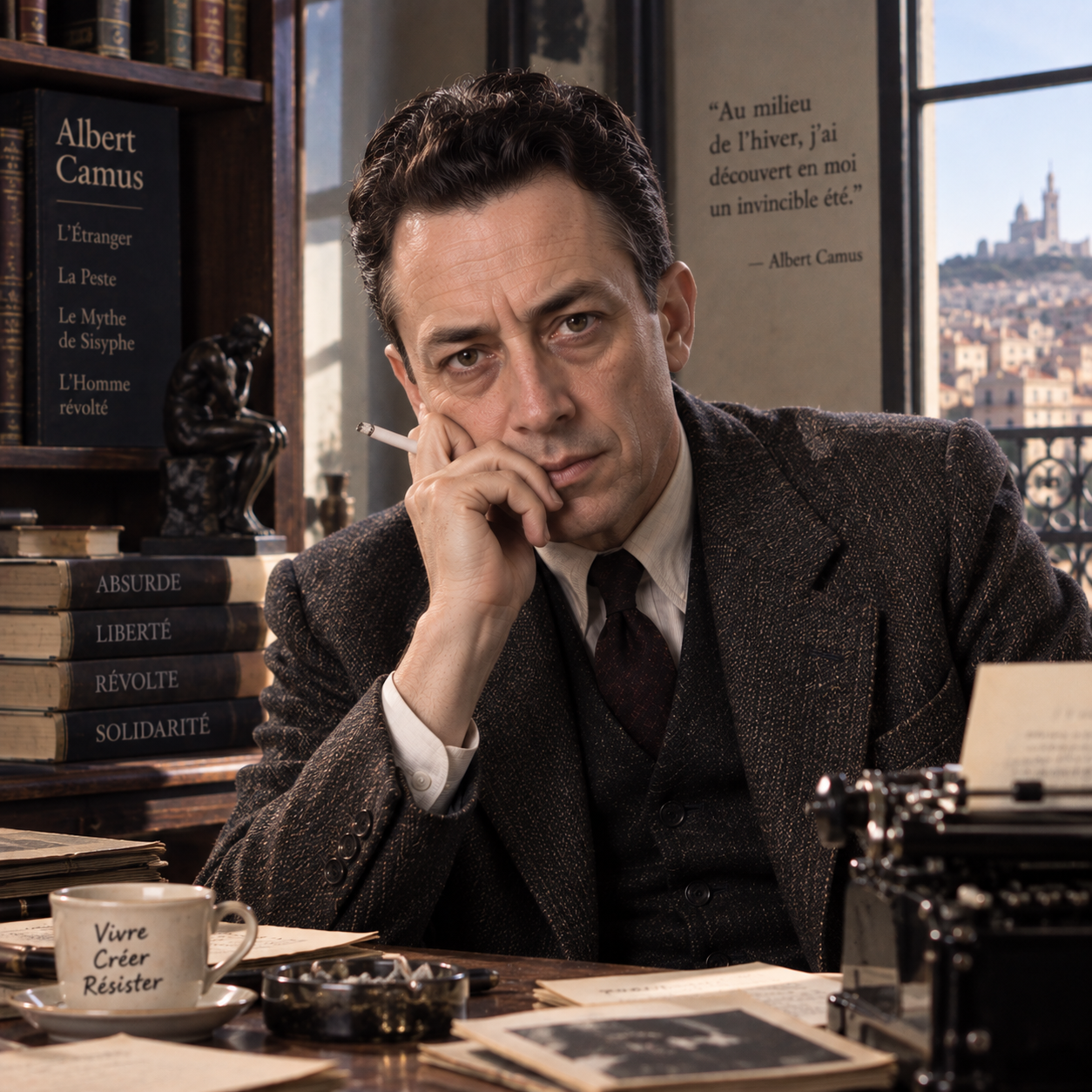
Known for
- Developing the philosophy of Absurdism
- The Stranger (L'Étranger)
- The Myth of Sisyphus
- The Plague (La Peste)
- 1957 Nobel Prize in Literature
Episodes featuring or mentioning this figure
No eligible published episode featuring this figure is currently in the library.