



Aldous Huxley
English writer and philosopher renowned for his dystopian classic Brave New World and exploration of mysticism.
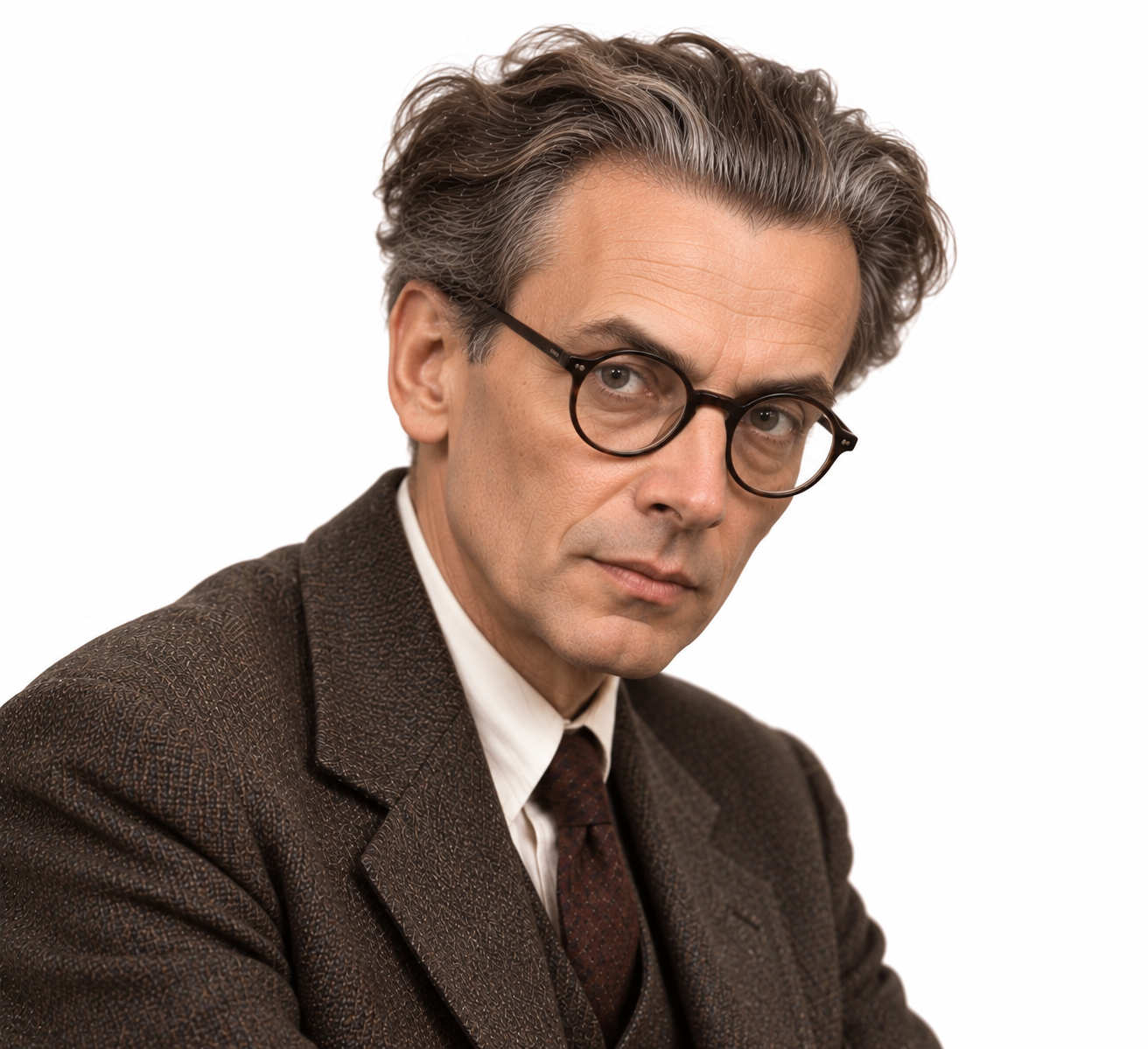
At a glance
- Born
- 1894 CE
- Died
- 1963 CE
- Era classification
- Modern
- Occupation
- Writer & Philosopher
- Homeland
- England
- Period
- 20th Century
- Field
- Philosophy & Ideology
- Language
- English
- Religion
- Perennial Philosophy
- Gender
- male
Biography
Aldous Leonard Huxley was born into the prominent intellectual Huxley family in Godalming, Surrey, England. Originally intending to pursue a career in medicine, a severe bout of keratitis punctata in his youth left him nearly blind for several years, ending his scientific laboratory aspirations. Instead, he turned his razor-sharp intellect toward literature and philosophy, graduating with high honors in English literature from Balliol College, Oxford, before establishing himself as a witty, biting satirist of contemporary bourgeois society with early novels like Crome Yellow and Point Counter Point.
In 1932, Huxley published his magnum opus, Brave New World, a groundbreaking dystopian vision set in a technologically advanced, consumer-driven future where human beings are genetically engineered, conditioned from birth, and pacified by a synthetic happiness drug called soma. The novel served as a prescient warning against totalitarian technocracy, the erosion of human dignity, and the seductive dangers of state-engineered comfort at the expense of authentic freedom and emotional depth.
During the late 1930s, Huxley relocated to Southern California, where his intellectual path shifted toward spiritual and metaphysical inquiry. Influenced by Eastern philosophies such as Vedanta and Mahayana Buddhism, he authored The Perennial Philosophy (1945), systematically exploring the recurring mystical truths underlying the world's major religions. In the 1950s, he became a pioneer in the study of consciousness expansion, famously documenting his transformative experiences with mescaline in The Doors of Perception (1954), a work that deeply influenced the burgeoning counterculture.
In his final novel, Island (1962), Huxley presented a utopian contrast to Brave New World, envisioning a balanced society integrating Western science with Eastern spiritual wisdom. Huxley passed away on November 22, 1963, leaving behind an extraordinary legacy that spans dystopian literature, philosophical inquiry, humanistic psychology, and the exploration of human consciousness.
Portrayal characteristics
Saved editorial descriptions used for the reconstruction; these are not authenticated statements by the depicted person.
- Visionary
- Intellectual
- Skeptical
- Mystical
- Curious
- Pacifist
Images & artwork 1
Known for
- Authoring the classic dystopian novel 'Brave New World'
- Writing 'The Doors of Perception' on psychedelics and consciousness
- Synthesizing spiritual traditions in 'The Perennial Philosophy'
- Penning the utopian counterpoint novel 'Island'
- Major contributions to 20th-century humanist and mystical thought
Episodes featuring or mentioning this figure
No eligible published episode featuring this figure is currently in the library.