



Sadegh Hedayat
Pioneering Iranian modernist author and translator renowned for his psychological fiction, notably The Blind Owl.
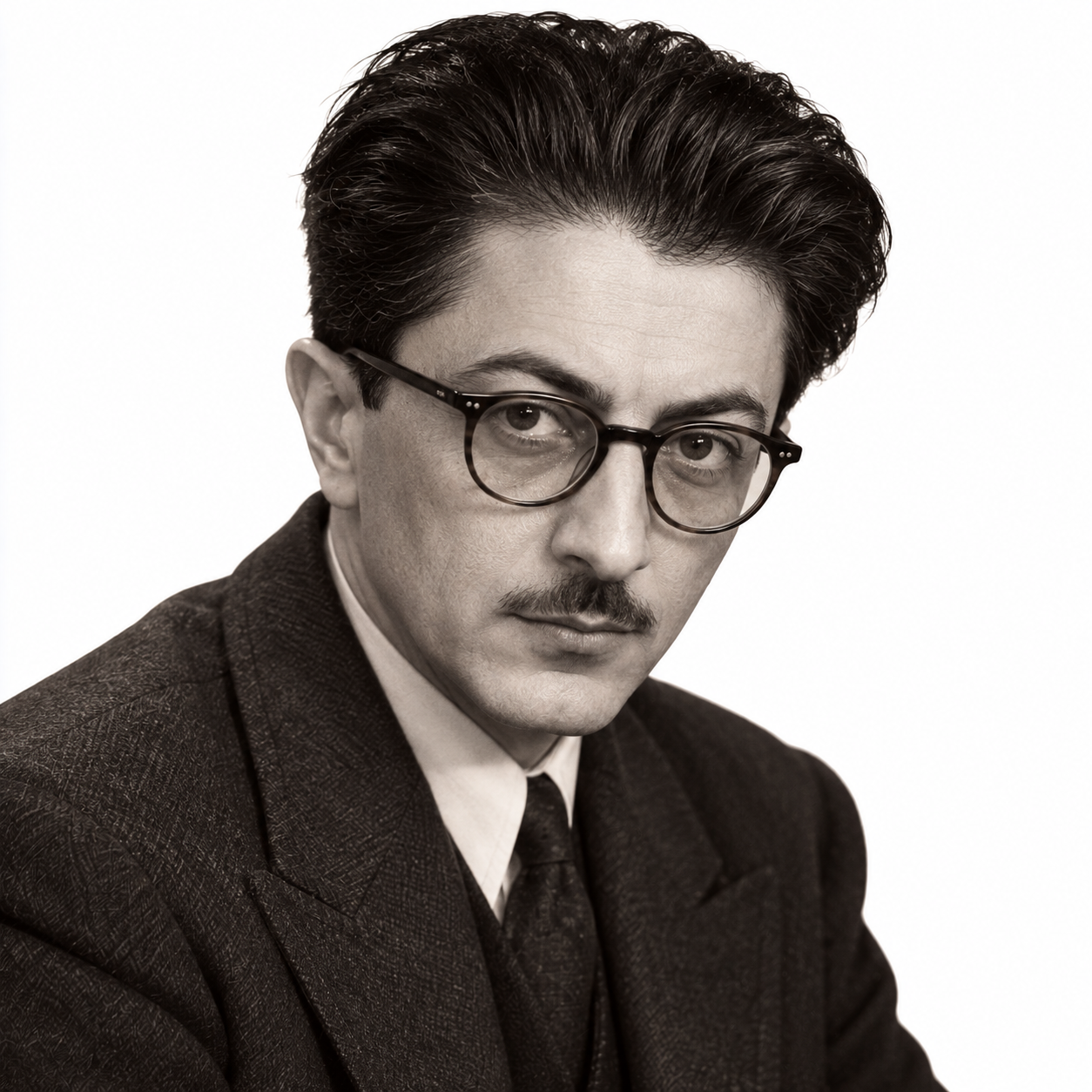
At a glance
- Born
- 1903 CE
- Died
- 1951 CE
- Era classification
- Modern
- Occupation
- Writer
- Homeland
- Iran
- Period
- Early 20th century
- Field
- Poetry, Art & Ethics
- Language
- Persian
- Religion
- Irreligious
- Gender
- male
Biography
Sadegh Hedayat was born into an aristocratic, politically prominent family in Tehran. He received an elite education, attending the Dar al-Fonun school and the French Catholic St. Louis School, where he developed a deep proficiency in French and a keen interest in world literature. Early on, he demonstrated a fascination with folklore, Iranian history, and vegetarianism, publishing his first notable essay, 'The Benefits of Vegetarianism', in 1927.
In the mid-1920s, Hedayat traveled to Europe on a state scholarship to pursue dentistry and later engineering in Belgium and France. Disillusioned with applied sciences, he abandoned his technical studies to immerse himself in European literary culture, reading heavily in modernist, symbolist, and existentialist works. Following a period of severe depression and an initial suicide attempt in the Marne River in 1928, he returned to Tehran in 1930. There, alongside contemporaries such as Bozorg Alavi, Masud Farzad, and Mojtaba Minovi, he established the 'Rab'eh' (The Foursome), an avant-garde literary circle that challenged the archaic conventions of traditional Persian letters.
Faced with domestic censorship under Reza Shah Pahlavi, Hedayat traveled to Bombay, India, in 1936. There, he studied Middle Persian (Pahlavi) with the Parsi Zoroastrian community and mimeographed a limited edition of his masterwork, 'The Blind Owl' ('Boof-e Koor'). Marked by surrealism, recursive motifs, and intense psychological introspection, the novella became a landmark in modern Persian fiction. Upon returning to Iran, Hedayat engaged in cultural scholarship, documented local oral folklore, translated the works of Franz Kafka and Jean-Paul Sartre, and produced sharp social satires such as 'Haji Aqa'.
During the political volatility of the late 1940s, Hedayat grew increasingly alienated from both the conservative establishment and partisan political movements. Plagued by creative despair, strict censorship, and chronic clinical depression, he relocated to Paris in late 1950. On April 9, 1951, he committed suicide by gas inhalation in his rented apartment after destroying his unpublished manuscripts. He was interred at the Père Lachaise Cemetery, leaving behind an influential legacy that reshaped 20th-century Persian literature.
Portrayal characteristics
Saved editorial descriptions used for the reconstruction; these are not authenticated statements by the depicted person.
- Melancholic
- Satirical
- Innovative
- Introspective
- Anticonformist
Images & artwork 2
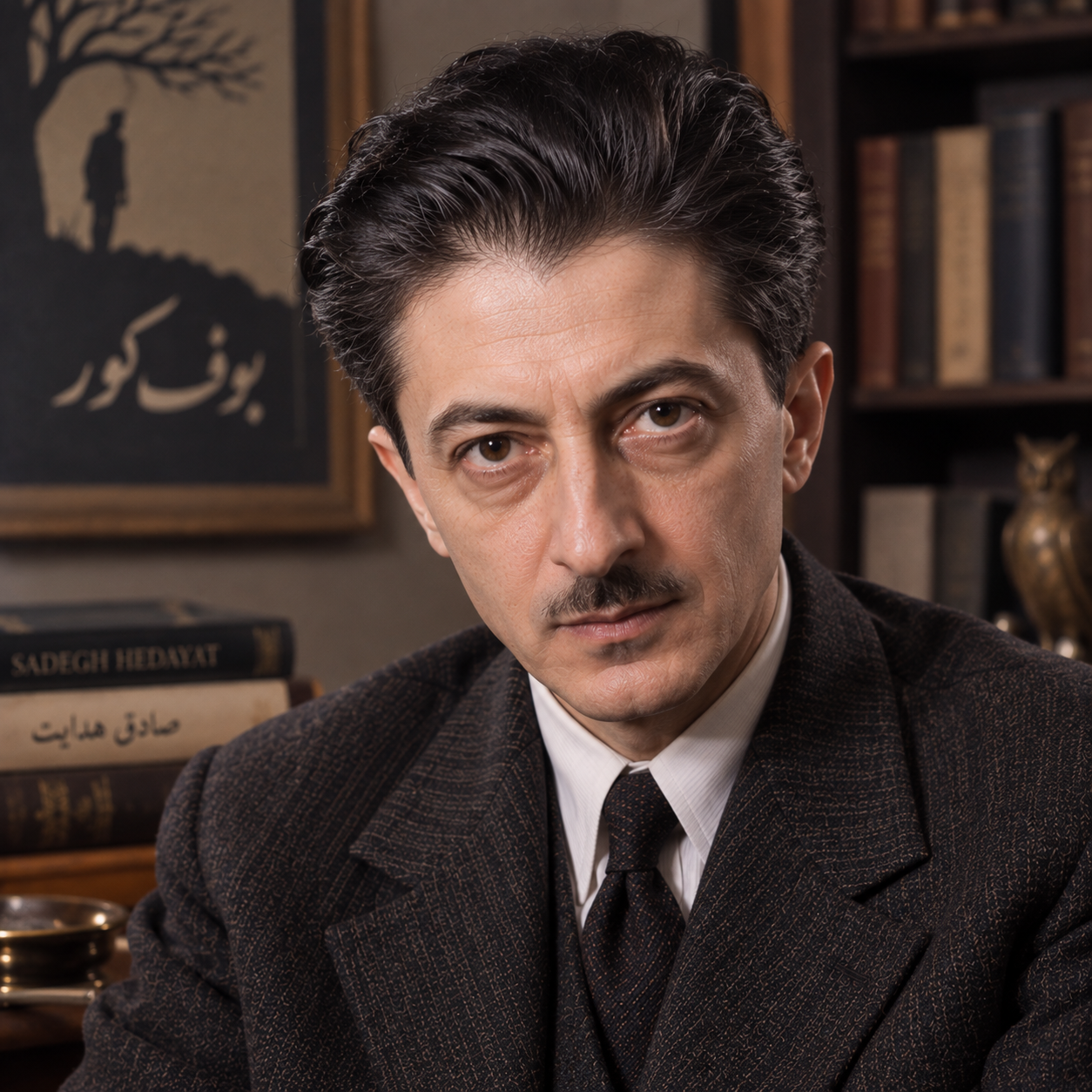
Known for
- Authoring the seminal psychological novel 'The Blind Owl' (Boof-e Koor)
- Pioneering modern literary realism and psychological fiction in Iran
- Co-founding the avant-garde 'Rab'eh' (The Foursome) literary circle
- Translating Franz Kafka and other European modernists into Persian
- Documenting and researching Iranian folklore and Middle Persian texts
Episodes featuring or mentioning this figure
No eligible published episode featuring this figure is currently in the library.