



Ibn al-Haytham (Alhazen)
Pioneering Arab polymath who revolutionized optics and established the foundations of the modern scientific method.

At a glance
- Born
- c. 965 CE
- Died
- c. 1040 CE
- Era classification
- Medieval
- Occupation
- Scientist (General)
- Homeland
- Abbasid Caliphate (modern-day Iraq) / Fatimid Egypt
- Period
- Islamic Golden Age
- Field
- Science & Innovation
- Language
- Arabic
- Religion
- Islam
- Gender
- male
Biography
Hasan Ibn al-Haytham, known in the Western world as Alhazen, was born in Basra during the Islamic Golden Age. Educated in civil administration, theology, and the sciences, he initially worked as a civil servant before dedicating his life entirely to the pursuit of mathematics, physics, astronomy, and philosophy. His intellectual brilliance quickly gained him widespread renown across the Islamic world.
His reputation led the Fatimid Caliph al-Hakim bi-Amr Allah to summon him to Cairo to undertake an ambitious engineering project: regulating the flooding of the Nile River. Upon surveying the terrain south of Aswan, Ibn al-Haytham realized the project was technologically impossible at the time. Fearing the erratic ruler's wrath, he reportedly feigned madness and was placed under house arrest in Cairo for approximately a decade until the Caliph's death in 1021 CE.
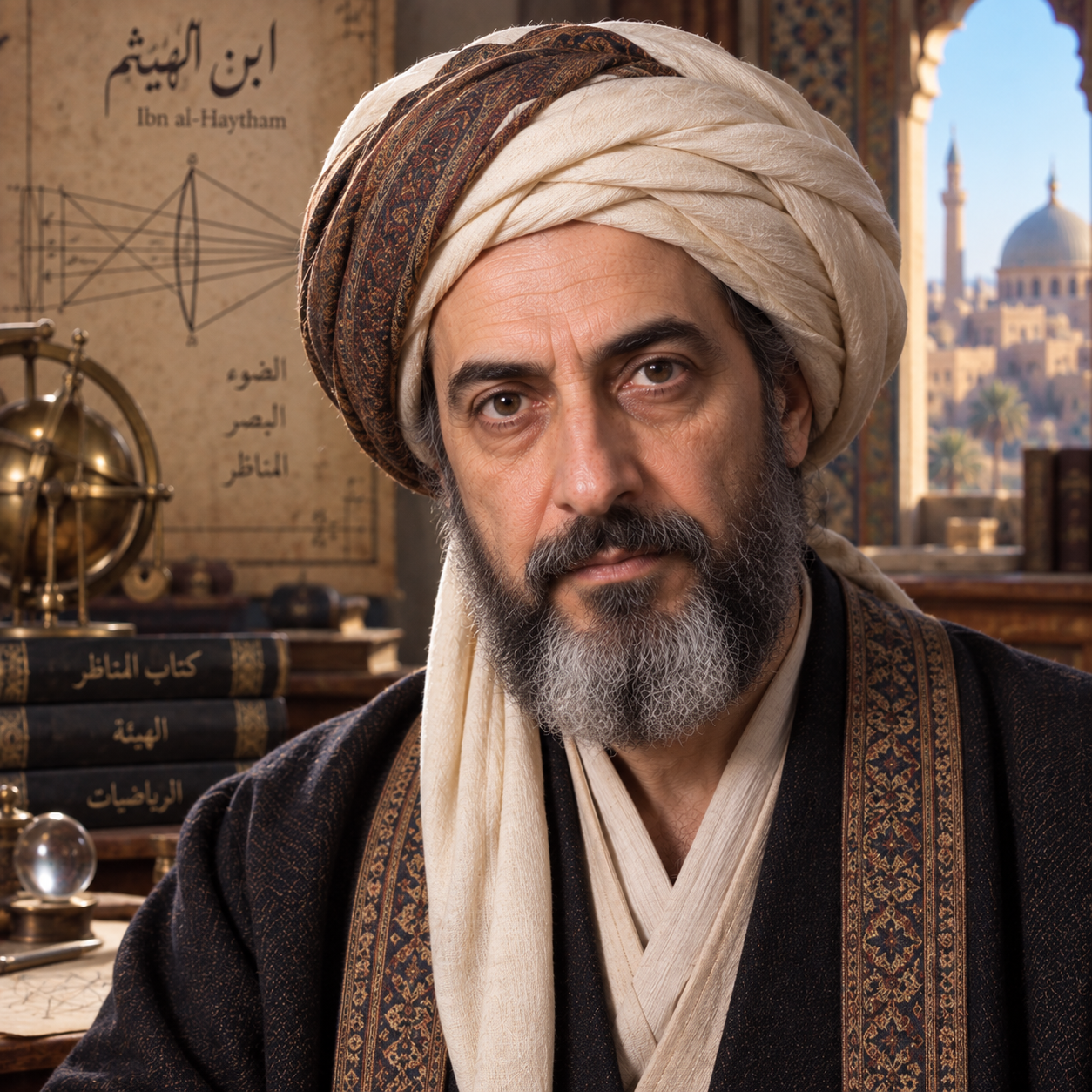
During his years of confinement, Ibn al-Haytham composed his monumental seven-volume masterpiece, the 'Kitab al-Manazir' (Book of Optics). He overturned centuries of established Greek thought by refuting the emission theory of vision championed by Euclid and Ptolemy, proving instead through rigorous empirical proof that light reflects off objects into the eye. His work meticulously explored the physics of reflection, refraction, spherical aberration, and the mechanics of the camera obscura.
Beyond optics, Ibn al-Haytham made profound contributions to celestial physics, spherical geometry, and early principles of integral calculus. His enduring legacy rests not only on his physical discoveries but on his epistemological revolution: he championed systematic, repeatable experimentation as the ultimate arbiter of scientific truth, making him widely recognized as the father of modern optics and the pioneer of the scientific method.
Portrayal characteristics
Saved editorial descriptions used for the reconstruction; these are not authenticated statements by the depicted person.
- Methodical
- Empiricist
- Inquisitive
- Rigorous
- Polymathic
Images & artwork 2
Known for
- Author of the 'Book of Optics' (Kitab al-Manazir)
- Pioneering the modern experimental scientific method
- Establishing the intromission theory of visual perception
- Experimental analysis of the camera obscura and pinhole image formation
- Formulation and geometric solution of Alhazen's problem
Episodes featuring or mentioning this figure
No eligible published episode featuring this figure is currently in the library.