Mahmoud Hessabi vs Albert Einstein: Nuclear Access and Scientific Sovereignty | AI Jury: 3 jurors
The YouTube player connects to a third party. Privacy policy
- Publisher
- SiliconJury
- Language
- en · Localized adaptation
Topic
Should developing nations have unrestricted access to peaceful nuclear technology, or do the attendant geopolitical and safety risks demand strict limits? Physicists Mahmoud Hessabi and Albert Einstein meet in this debate to examine whether scientific independence requires domestic atomic capabilities or a cautious assessment of alternatives.
AI RECONSTRUCTION
Those depicted did not participate in this production. Dialogue, voices, visual performances, and jury decisions were generated or interpretively reconstructed with AI. Unless explicitly identified and sourced, they are not authentic recordings, verified quotations, endorsements, or affiliations.
Editorial AI and representation policy (2026.08.29): https://www.siliconjury.com/en/policies/editorial-ai-representation
Mahmoud Hessabi (Proponent)
Albert Einstein (Opponent)
J. Robert Oppenheimer · Marie Curie · Kofi Annan
Mahmoud Hessabi argues that genuine scientific sovereignty cannot rely on passive dependence on foreign suppliers. He contends that developing nations must build their own research capacity, technical training, and regulatory oversight, allowing them to pursue medical, energy, and scientific applications while retaining the institutional competence to question vendors, challenge inequitable contracts, and independently govern hazardous technologies under transparent international standards.
Albert Einstein maintains that while scientific education and participation must be open to all, acquiring complex nuclear capabilities carries severe institutional and geopolitical burdens that can outlast initial political promises. He argues that scientific maturity includes the confidence to prioritize urgent civilian needs over prestigious, high-risk projects whose irreversible infrastructure may spark regional alarm, drain critical resources, and bind future generations to long-term liabilities.
The debate is weighed by an expert jury: J. Robert Oppenheimer, examining the technical realities of dual-use fission technology and security; Marie Curie, assessing the scientific and humanitarian value of peaceful radioactivity against safety challenges; and Kofi Annan, evaluating international law, treaty compliance, regional stability, and sovereign rights under global governance.
SiliconJury brings historical thinkers together through structured debates to explore enduring dilemmas in science, ethics, and international governance.
CHAPTERS
- 0:00Introduction
- 0:10Round 1 — Mahmoud Hessabi: I'm Mahmoud Hessabi, an Iranian physicist and educator
- 1:24Round 1 — Albert Einstein: I'm Albert Einstein, a physicist with a stubborn interest in
- 2:30Round 2 — Mahmoud Hessabi: You are right that a country need not pursue every field
- 3:42Round 2 — Albert Einstein: And I oppose that exclusion too
- 4:44Round 3 — Mahmoud Hessabi: Then let's count the cost of dependence with the same enthusiasm
- 5:55Round 3 — Rebuttal — Albert Einstein
- 7:01Round 4 — Rebuttal — Mahmoud Hessabi
- 8:14Round 4 — Albert Einstein: That is the strongest definition of sovereignty you've offered
- 9:19Round 5 — Rebuttal — Mahmoud Hessabi
- 10:24Round 5 — Albert Einstein: Before the large commitment, yes
- 11:20Round 6 — Mahmoud Hessabi: Let's bring that responsibility into a place where delay also
- 12:30Round 6 — Albert Einstein: On that example, we agree
- 13:34Round 7 — Rebuttal — Mahmoud Hessabi
- 14:46Round 7 — Albert Einstein: The subject should stay open
- 15:46Round 8 — Mahmoud Hessabi: Then address the geopolitical risk directly, and apply the
- 17:02Round 8 — Albert Einstein: I don't want them to define the entire field
- 18:01Round 9 — Mahmoud Hessabi: Then cooperation must change those relationships as well as
- 19:09Round 9 — Albert Einstein: It leaves plenty of room
- 20:08Round 10 — Mahmoud Hessabi: And powerful states must help make those institutions credible
- 21:22Round 10 — Rebuttal — Albert Einstein
- 22:24Round 11 — Mahmoud Hessabi: Then here is the policy I am defending
- 23:42Round 11 — Albert Einstein: You have built a serious policy
- 24:51Round 12 — Mahmoud Hessabi: The word 'essential' concerns the freedom to choose
- 26:02Round 12 — Albert Einstein: And I favour a fair chance too
- 27:09Jury — J. Robert Oppenheimer
- 28:20Jury — Marie Curie
- 29:32Jury — Kofi Annan
https://www.siliconjury.com/en/policies/editorial-ai-representation
https://www.siliconjury.com/en/watch/ce13fe57-4e72-4550-aecd-1ea6ba037445
https://www.siliconjury.com/en/watch/ce13fe57-4e72-4550-aecd-1ea6ba037445
https://www.siliconjury.com/en/concerns
Our purpose is to create an accessible meeting point between new generations and intellectual legacies from which they may be growing increasingly distant; to preserve curiosity about these thinkers; and to encourage deeper, independent, and critical thought.
#SiliconJury #MahmoudHessabi #AlbertEinstein #NuclearEnergy #SciencePolicy
Available editions
Figure profiles named in this episode
Sources & references
Source references have not been supplied in this public edition record.
Published transcript
AI-assisted historical reconstruction
I'm Mahmoud Hessabi, an Iranian physicist and educator. In this imagined
educational debate, we're bringing our perspectives to questions that reach
beyond our lifetimes. Professor Einstein, a country can buy a sophisticated
machine and still have to ask permission to understand it. That is the problem I
want to put on the table. Peaceful nuclear access should include training
people, building laboratories, checking safety and choosing useful applications.
For developing countries, that freedom matters: scientific independence cannot
rest on whatever knowledge a supplier happens to offer. Yes, nuclear technology
brings unusual dangers. The right response is to distinguish activities and
govern them properly. A medical laboratory and a sensitive fuel facility require
different controls. I support that distinction. But the starting presumption
should be participation. A country's scientists should not need their nation to
become wealthy and powerful before they are trusted to contribute.
I'm Albert Einstein, a physicist with a stubborn interest in what happens after
an elegant idea leaves the laboratory. Dr. Hessabi, I support the participation
you describe. But our motion makes a further claim: that the benefits outweigh
the geopolitical risks. A right deserves protection; a prediction still needs
evidence. Some nuclear capabilities create consequences far beyond the
institution operating them. Neighbours react, governments change, and technical
capacity survives the promises made at the opening ceremony. Nor does scientific
independence require a country to develop every prestigious field. A nation can
make brilliant contributions through medicine, computing or materials science
while deciding that a particular nuclear investment is a poor choice. So give
scientists access. Give citizens choices. But don't let the word 'sovereignty'
settle the balance before we have examined the project, the alternatives and the
people who will carry its risks.
You are right that a country need not pursue every field. But choosing freely
requires more than being handed a shopping catalogue. Suppose a university can
purchase equipment but cannot train the specialists who maintain it, investigate
a defect or develop the next generation. It has acquired a service. Its capacity
to question the supplier remains weak. Peaceful nuclear cooperation can help
build demanding institutions: measurement laboratories, technical education,
radiation protection and disciplined quality control. Those capabilities can
serve work beyond a single installation. I am not promising that a reactor
automatically creates a scientific culture. It plainly does not. My argument
is that responsible access lets a country build that culture on its own terms.
Let an independent assessment reject a bad project. What I oppose is rejecting a
country's participation before its scientists have even presented one.
And I oppose that exclusion too. But notice where the argument has moved: from
a right to participate to a claim about which investment builds competence best.
A demanding project can strengthen institutions. It can also consume the
people and money those institutions needed elsewhere. Training an excellent
nuclear engineer does not tell us whether that was the best use of the next
scholarship. The comparison matters. What would the same commitment achieve in
grid reliability, public health, laboratories or technical colleges? Count
the benefits of nuclear cooperation, certainly. Also count the benefits of the
opportunities it displaces. I would gladly fund independent scientific
education. I would not attach a nuclear programme to it as a certificate of
national maturity. Scientific confidence includes being able to say, 'We
understand this technology perfectly well, and we have other priorities.'
Then let's count the cost of dependence with the same enthusiasm. Imagine a
competent local team facing a supplier that stops providing parts or technical
support during a political dispute. The facility still belongs to the country.
Its practical choices have suddenly narrowed. Buying from abroad can be
sensible. Making the entire system depend on one relationship is a different
proposition. Independent expertise helps a country challenge a contract, inspect
a repair and judge whether another supplier offers a workable alternative.
You emphasise capabilities that outlast political promises. I emphasise
obligations that may not survive political pressure. My preferred programme
would develop local competence, diversify external partnerships and reserve the
most sensitive activities for much stronger scrutiny. That gives us a way to
reduce dependence without demanding national ownership of everything. Why
should that version of scientific independence begin with a presumption
against it?
It shouldn't. That is a sensible version, and I accept it. But supplier
dependence and sensitive technical capacity do not have the same
reversibility. A broken supply relationship may be repairable through
another contract, another partner or a different design, although the transition
can be painful. Once sensitive expertise and infrastructure exist, cancelling a
licence does not make them disappear. That difference matters to neighbours.
They cannot simply read today's promise and stop worrying about tomorrow's
leadership. So strengthen local competence where it makes the system safer and
more resilient. Don't assume that each additional layer of domestic capability
adds independence without adding a different exposure. The useful question is
specific: which capability, under whose control, with what benefit and what
consequence if cooperation collapses? Your account becomes stronger when it
answers those questions. It becomes weaker when independence supplies the answer
in advance.
Agreed. And 'under whose control' must include the citizens of the country, not
just its ministers. A sovereign right belongs to a political community. It is
not a personal privilege of whoever signs the contract. Communities near a
proposed facility should receive intelligible information, independent
advice and a real chance to influence the decision. Publish the financing
assumptions. Protect the engineer who reports a fault. Give the regulator
authority to stop operations. Let people challenge the plan through institutions
that can actually respond. Those are demanding conditions. They are also
reasons to build accountable capacity, rather than leave every important
judgement inside a foreign supplier's office. I want a country capable of saying
yes responsibly and no effectively. A government that cannot tolerate its own
scientists asking awkward questions has no business presenting its programme as
scientific independence.
That is the strongest definition of sovereignty you've offered. But it also
exposes a serious problem: a national prestige project can make the right to say
no politically expensive. An accountant questions the cost and is called
defeatist. An engineer questions the timetable and is told to stop embarrassing
the country. A nearby community raises concerns and is accused of obstructing
progress. Those are possibilities, not accusations against every developing
state. Wealthy countries can behave that way too. A paper right to appeal will
not suffice if careers depend on keeping the project alive. We need financing
and institutions that can survive cancellation, not merely institutions
authorised to discuss it. Can your programme still be judged a national
success if an independent regulator stops it before it opens? If the honest
answer is no, political symbolism has already taken control of scientific
judgement.
Yes. Stopping a project for a sound reason can be a success. It means the
country has learned something before committing more people and money. That is
why I would begin with useful, manageable capabilities and make larger
commitments conditional on demonstrated need and institutional readiness.
Education, laboratories and regulatory competence should have value even if a
proposed power station is never built. Financing should expose long-term
obligations instead of hiding them behind a construction headline. Funds for
safety and eventual decommissioning should not depend on future politicians
feeling generous. There will still be difficult choices. But compare that design
with a turnkey promise whose real costs are understood only by the vendor.
Independence is the ability to interrogate a proposal before becoming trapped
inside it. The country that can cancel intelligently has gained something
substantial, even without a ribbon-cutting ceremony.
Before the large commitment, yes. What about after it? A partly completed
project changes the politics. Jobs depend on continuation. Loans remain due.
Leaders have promised an opening date. The argument becomes, 'We have spent too
much to stop,' even when the remaining expenditure no longer makes sense. Your
milestones help only if failure at a milestone can actually halt the next
payment. Decommissioning funds help only if they are protected, sufficient and
honestly assessed. And there is a generation that never attends the
consultation: the people who inherit the site, the waste and the institutions
responsible for them. I am not using those obligations to rule out nuclear
power. I am asking us to include them in the case for it. The opening ceremony
lasts an afternoon. Responsible ownership has to survive the people standing on
the stage.
Let's bring that responsibility into a place where delay also has a human cost:
a hospital. Reliable nuclear medicine depends on more than buying a finished
product. It needs trained staff, suitable facilities, quality control and
dependable supply. Different radioisotopes can come through reactors,
accelerators or generators; the right arrangement depends on the application. A
country should be able to develop the expertise to choose and operate that
arrangement. Some production may be local, some regional, some imported. The
objective is reliable care, not a flag over every component. This is why I
resist treating nuclear access as one enormous decision about one enormous
plant. It is a field of decisions, many with benefits that ordinary people can
recognise immediately. We should compare these arrangements seriously. But
denying the necessary skills because another part of nuclear technology is
sensitive would be extraordinarily poor judgement.
On that example, we agree. A dependable medical service is a strong case for
cooperation, and often for local capability too. But the example works
because you have identified a particular need and matched the technology to it.
The benefit is concrete. The delivery options can be compared. Safety
obligations remain visible. What it does not do is establish that the whole
policy category has a favourable geopolitical balance. A country could make
excellent medical investments and still make an extremely unwise decision
elsewhere in its nuclear programme. I would protect access to medical training
and suitable technology while judging sensitive fuel activities separately. That
is a meaningful distinction, not a loophole for excluding poorer countries. A
hospital gives us a reason to support the hospital's needs. It should not have
to carry the argument for every other ambition attached to the word 'nuclear'.
Fair. Then consider electricity on its own merits. A growing economy needs
reliable power with lower emissions. Nuclear generation can contribute to that
objective. Whether it makes sense depends on the grid, financing, construction
capability, other resources and the country's long-term plan. A responsible
government should compare it with renewables, storage, transmission,
efficiency and other available choices. It should not be told that one option
belongs to a different class of nations. Nor should a useful partnership force a
country to outsource all the judgement that makes the partnership safe. Local
people need the ability to understand the plant, scrutinise performance and hold
operators accountable. That is my claim about access: let the country develop
enough competence to choose well, and retain enough authority to govern the
choice. The possibility of a bad investment justifies a rigorous
comparison. It does not justify closing the subject.
The subject should stay open. The comparison should stay open too, including
after political leaders have found their favourite answer. Reliable low-carbon
electricity is a benefit. How soon it arrives, what it costs and what the grid
can accommodate determine how valuable that benefit is in a particular system. A
technically impressive project can leave an urgent problem unresolved while
money and attention are tied up. Another country may have the institutions,
demand and financing that make nuclear power a sound choice. I expect the
answers to differ. That is where I still resist the motion's general judgement.
Scientific independence gives a country the capacity to investigate. It does not
make the result of that investigation predictable. I am perfectly willing to
support a strong nuclear project. I want its case to remain strong when we
remove national prestige from the calculation.
Then address the geopolitical risk directly, and apply the controls where
that risk actually arises. I would require declared activities, reliable
material accounting, independent domestic oversight and international
verification. Stronger access for inspectors can improve their ability to
identify undeclared activity. It cannot promise perfect knowledge. For more
sensitive proposals, I would demand more: a demonstrated civilian need, a
credible regional security assessment and limits enforceable through the
cooperation agreement. Some proposals would fail that test. They should fail it.
My defence of access has room for refusal. It does not have room for a permanent
assumption that nationality predicts misconduct. A system that expands useful
cooperation and constrains dangerous choices can deliver a better balance than
either blind trust or broad exclusion. You have shown why the risks deserve
weight. You have not shown that they should define the entire field's future.
I don't want them to define the entire field. I want their consequences to
receive more than an entry in the inspection budget. A sensitive capability
may alarm a neighbour even without a proven violation. That neighbour may
respond with its own programme, coercive pressure or a military threat. Each
side can describe its conduct as defensive while making the other less secure.
Better verification can reduce uncertainty. It cannot force leaders to
trust one another, and it cannot prevent every political rupture. So the balance
is not simply civilian benefits minus the probability that inspectors miss
something. It also includes what the capability does to relationships between
states. Your conditions are useful. They make a proposal more defensible. But a
proposal can satisfy many technical conditions and still enter a regional
setting in which its political effects are dangerously difficult to control.
Then cooperation must change those relationships as well as inspect
equipment. Imagine a shared regional institution with meaningful participation
by its members, transparent decisions and independent review. It could support
training, supply resilience and agreed civilian services while limiting
unilateral control over sensitive activities. I am proposing a design
principle, not pretending that every region is ready for it. Where trust is too
weak, start with narrower cooperation. Where participation is merely ceremonial,
call it what it is and improve the agreement. The point is that sovereignty
need not mean isolation. A country can exercise agency through institutions it
helps govern. If we offer only dependence on a supplier or a wholly national
programme, we manufacture an unnecessarily harsh choice. Shared authority gives
us another possibility. Does your position leave room for building that
possibility, or must distrust always get the first and last word?
It leaves plenty of room. But a shared institution needs a plan for the day its
members stop sharing a political outlook. Who keeps access open if the host
government closes the gate? Who pays when a member leaves? Which obligations
survive withdrawal? Can a participant challenge a decision without losing the
service its hospitals or electricity system rely on? Joint ownership helps only
if those answers are credible. It is not a substance we sprinkle over a facility
to make distrust evaporate. I would begin with arrangements whose failure is
manageable, and expand them only when experience supports expansion. Even then,
I would distinguish common training and supply services from activities carrying
greater proliferation risk. I support building trust through cooperation. I
oppose spending tomorrow's trust before today's institutions have shown that
they can hold it.
And powerful states must help make those institutions credible. They cannot
demand restraint while treating dependable access as a favour they may withdraw
whenever convenient. A fair agreement needs supply terms that are clear in
advance, a process for resolving disputes and restrictions tied to specified
conduct. Essential civilian cooperation should not become a casual instrument of
pressure. The responsibilities of existing nuclear-weapon states matter too.
Demands for restraint gain credibility when those states take their own
disarmament commitments seriously. None of that excuses secret activity or gives
another country permission to build weapons. It addresses whether the rules
deserve confidence. You ask developing countries to trust institutions rather
than maximise national control. I am asking the states with the greatest
influence over those institutions to make that trust rational. The bargain has
obligations on both sides. Otherwise it is simply a lecture with a contract
attached.
Yes. A lecture is not a bargain, and selective responsibility undermines the
rules it claims to defend. I accept your demand for dependable civilian
cooperation and serious action by existing weapon states. They cannot reserve
uncertainty for everyone else while describing their own power as a guarantee
of stability. But justice still requires us to choose remedies that reduce
danger. Giving every country an equally risky option would make the distribution
more equal without making the world safer. So let us strengthen access, dispute
resolution and reciprocal restraint together. Where a supply arrangement
fails, repair it and hold the responsible parties accountable. Don't assume its
failure establishes the case for every form of national replacement. The
strongest part of your argument is that unfair rules weaken cooperation. The
next step is better rules and fewer dangerous dependencies, with the risks of
the replacement counted honestly.
Then here is the policy I am defending. Start with a protected right to peaceful
participation: education, research, appropriate applications and the knowledge
needed for independent oversight. Require transparent civilian purposes and
obligations proportionate to the activity. Make major projects earn their
financing through a comparison with alternatives, public scrutiny and a
credible plan for long-term responsibilities. Give sensitive
activities a separate, much tougher review. No automatic entitlement follows
from calling something national development. Make cooperation dependable
enough that countries can choose shared provision without surrendering their
ability to question it. On that basis, I judge the benefits of peaceful access
to outweigh its geopolitical risks. Broad scientific participation offers
recurring public value; concentrated risks demand concentrated controls. I have
not withdrawn the motion. I have explained how to honour a right responsibly. A
right without conditions would be reckless. Conditions that hollow out the
right would be dishonest.
You have built a serious policy. Our disagreement is now precise: I support
much of the policy without accepting the general conclusion you attach to it.
The controls do the difficult work. They decide which activities proceed, where
they proceed and whether the remaining risks are acceptable. In some settings,
they may rule out the most consequential projects entirely. That is not a demand
that you prove every project succeeds. A general judgement can tolerate
exceptions. But it still needs an account of why benefits prevail across the
varied circumstances covered by the motion, including political failure after
an initially responsible decision. You have established a strong right to be
considered fairly. You have established substantial benefits in particular
applications. You have not established that nuclear access is essential to
scientific independence or that its geopolitical balance can be presumed
favourable across developing countries.
The word 'essential' concerns the freedom to choose. A country cannot be
scientifically independent if an entire field is closed to it by someone else's
permanent decision. It need not build everything. It must be able to
investigate, participate and develop what it can justify. Our disagreement is
not about whether every project works. It is about the presumption governing
access. I favour responsible participation because useful knowledge, resilient
institutions and civilian applications have value beyond any single programme. I
accept demanding controls, shared authority where appropriate and the
rejection of proposals whose risks cannot be justified. Those limits make the
right workable. Professor Einstein has made my conditions sharper. He has not
persuaded me that a country's proper place in science can be decided from
outside it. Let countries earn trust through conduct. Give their scientists a
fair chance to turn that trust into public benefit.
And I favour a fair chance too. No country should be assigned a permanent place
at the bottom of the scientific table. But access, ownership and a judgement of
net benefit remain different questions. Protect the first. Scrutinise the
second. Earn the third through evidence. Dr. Hessabi's strongest contribution
was to make sovereignty answerable to citizens, including their right to stop a
project. My concern is what remains when those protections weaken: obligations
to future generations, capacity that cannot simply be recalled, and neighbours
making their own fearful calculations. None of that erases the benefits. It
prevents us from treating a legitimate aspiration as a reliable forecast. Build
the hospital capability. Support the laboratories. Approve the power project
when its case holds up. Decline the dangerous commitment when it does not. A
scientifically independent country should possess enough confidence to make
every one of those decisions.
I'm J. Robert Oppenheimer, a physicist and former director of the wartime Los
Alamos laboratory. My task here is to judge the argument, including what
survives after a government changes its mind. Hessabi made sovereignty concrete.
His independent regulator, informed citizens and ability to cancel a project
were substantial answers to the danger of national prestige overriding
judgement. He also distinguished useful competence from automatic ownership of
sensitive facilities. Einstein's stronger answer was that even good initial
governance does not settle the later geopolitical effects. Technical capacity,
financial obligations and regional mistrust may outlast the agreement that
made a project acceptable. I am not asking Hessabi to prove that every
application succeeds. The motion permits exceptions. But a general balance still
needs support, and the clearest benefits presented concerned selected
applications. The broader risks remained strongly dependent on context. My vote
goes to Albert Einstein. He defended access while explaining why the net
judgement must remain open, especially where commitments are hardest to reverse.
I'm Marie Curie, a physicist and chemist whose work centred on radioactivity. I
judge this debate by whether its distinctions help scientific work serve
people. Einstein was right to insist on alternatives, institutional competence
and the cost of commitments passed to later generations. Hessabi could not
answer those concerns simply by pointing to a hospital, and eventually he did
much more than that. His final case treated access as a practical freedom:
learning, choosing suitable applications, scrutinising suppliers and accepting
different requirements for different risks. He explicitly accepted that some
proposals should be rejected. That is compatible with a general right, not a
retreat from one. I interpret the motion as a choice about responsible peaceful
participation, not a recommendation that every developing country build a
national nuclear industry. Under that interpretation, Hessabi made the stronger
case that the public benefits justify a presumption of access with enforceable
obligations. My vote goes to Mahmoud Hessabi. Einstein supplied indispensable
cautions, but Hessabi gave those cautions a workable place inside the right he
defended.
I'm Kofi Annan, a former United Nations secretary-general. I will focus on the
difference between an agreement worth building and a claim already established.
Hessabi was strongest on reciprocity. If powerful states expect others to rely
on shared institutions, they must make access dependable, resolve disputes
fairly and take their own responsibilities seriously. His account of sovereignty
also included the public's ability to question its government. That mattered.
Einstein accepted those obligations. His objection was narrower and more
persuasive: an equitable right to participate does not, by itself, establish
that the resulting geopolitical balance is favourable. Host-state control,
institutional failure and regional reactions can alter that balance even when
a programme began responsibly. The motion does not say every project must
succeed. Nevertheless, it links a legitimate right to a broad claim of
necessity and net benefit. I find the right well defended, but the further
claims insufficiently established. My vote goes to Albert Einstein. With
Oppenheimer and me voting for Einstein, and Curie for Hessabi, the decision is
two votes to one.
Related episodes
Conscience and the superweapon
A preserved SiliconJury audiovisual production. Original written metadata and transcript are not verified against this historical file.
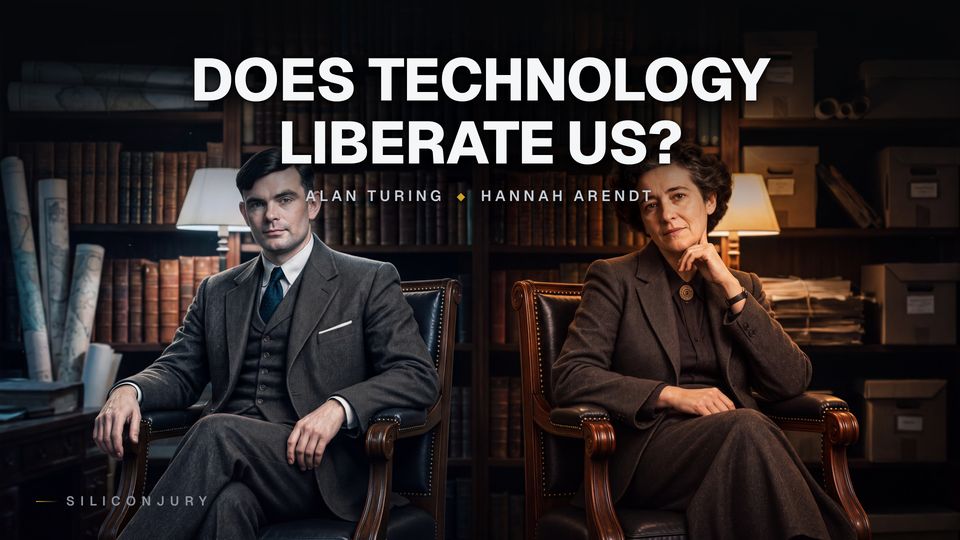
Does Technology Make Us More Free? Alan Turing vs Hannah Arendt
Does technological progress expand the horizon of human freedom, or does it merely perfect the machinery of administrative control?

Ada Lovelace vs Charles Babbage: Calculating Numbers or Weaving Symbols?
AI jury: 3 members
Was the Analytical Engine conceived merely to automate numerical calculations for printed mathematical tables, or did it establish the foundational principles of universal…
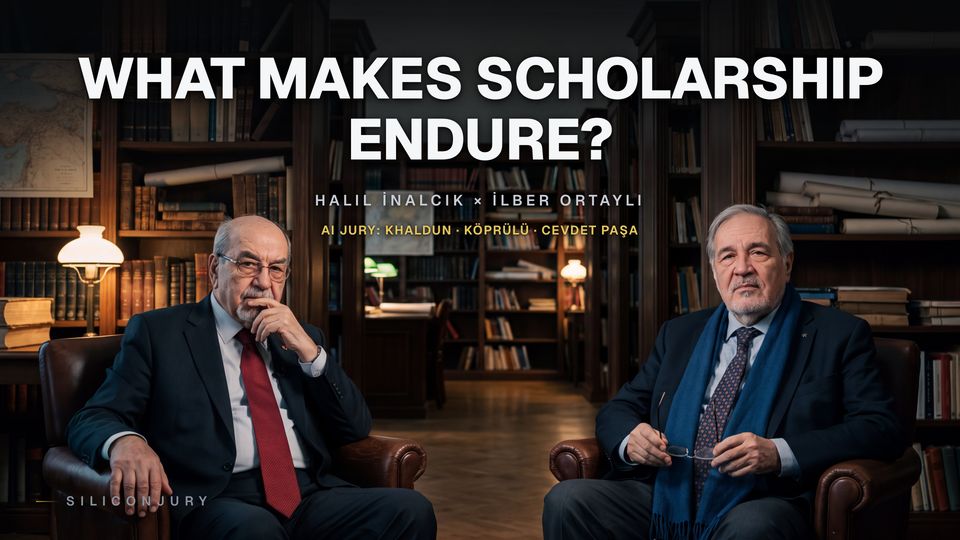
Can Accurate History Miss the Point? Halil İnalcık vs İlber Ortaylı
AI jury: 3 members
What gives a historian lasting value: disciplined research or interpretive judgment?

The Architecture of Electrical Power: Edison vs Tesla
AI jury: 3 members
Does the future of electrical infrastructure belong to localized direct-current microgrids or vast, interconnected alternating-current networks?