



Hedy Lamarr
Austrian-American actress and inventor who co-patented frequency-hopping spread spectrum technology.
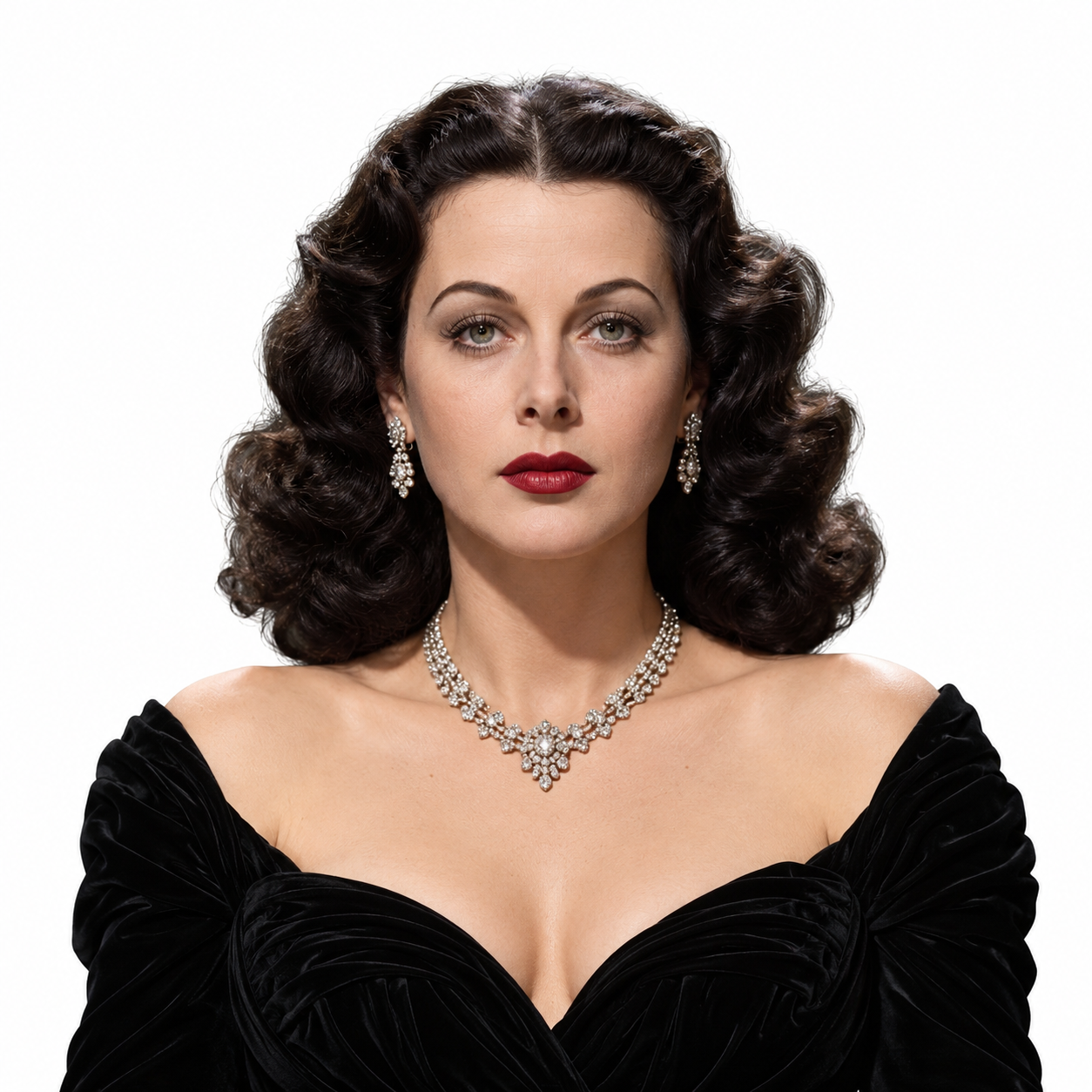
At a glance
- Born
- 1914 CE
- Died
- 2000 CE
- Era classification
- Modern
- Occupation
- Actress and Inventor
- Homeland
- Austria
- Period
- 20th Century
- Field
- Science & Innovation
- Language
- German
- Religion
- Judaism
- Gender
- female
Biography
Hedy Lamarr was born Hedwig Eva Maria Kiesler in Vienna, Austria-Hungary, in 1914 to an assimilated Jewish family. Drawn to the performing arts at a young age, she studied acting and secured early roles in Austrian and German theatre and film, gaining international attention with the 1933 Czechoslovak drama "Ecstasy." That same year, she married Friedrich Mandl, an Austrian arms manufacturer. Accompanying Mandl to business dinners and technical conferences, Lamarr acquired a practical understanding of military electronics and munitions before fleeing the controlling marriage in 1937.
After escaping to Paris and London, she met Metro-Goldwyn-Mayer studio chief Louis B. Mayer, who signed her to a Hollywood contract and introduced her under the stage name Hedy Lamarr. Quickly established as one of the era's most prominent screen beauties, she starred opposite leading actors in pictures such as "Algiers" (1938), "Boom Town" (1940), and "Comrade X" (1940). Her commercial acting pinnacle came with Cecil B. DeMille's biblical epic "Samson and Delilah" (1949), which became one of the highest-grossing films of the decade.
Alongside her Hollywood career, Lamarr maintained a private workshop and pursued technical inventions. During World War II, concerned by the threat of Axis submarine warfare against Allied shipping, she collaborated with avant-garde composer George Antheil to develop a radio guidance system for torpedoes. Drawing inspiration from synchronized player-piano mechanisms, they designed a system that coordinated frequency changes across 88 radio frequencies, rendering the guidance signal resistant to enemy detection and jamming. They were granted U.S. Patent No. 2,292,387 for this "Secret Communication System" in August 1942.
Although the U.S. Navy did not immediately adopt the system, the concept of frequency-hopping spread spectrum was revitalized during the Cold War and incorporated into naval communications during the 1962 Cuban Missile Crisis. The principles Lamarr and Antheil patented later served as foundational building blocks for modern digital wireless communications, including cellular networks, Wi-Fi, and Bluetooth. Lamarr lived her later decades in relative seclusion in Florida, receiving delayed recognition including the Electronic Frontier Foundation Pioneer Award in 1997, and was posthumously inducted into the National Inventors Hall of Fame in 2014.
Portrayal characteristics
Saved editorial descriptions used for the reconstruction; these are not authenticated statements by the depicted person.
- Inventive
- Inquisitive
- Independent
- Resilient
- Forward-thinking
Images & artwork 2

Known for
- Co-inventing frequency-hopping spread spectrum technology (U.S. Patent 2,292,387)
- Leading roles in Classic Hollywood films, notably 'Samson and Delilah' and 'Algiers'
- Induction into the National Inventors Hall of Fame in 2014
- Recipient of the Electronic Frontier Foundation Pioneer Award in 1997
Episodes featuring or mentioning this figure
No eligible published episode featuring this figure is currently in the library.