



Geoffrey Everest Hinton
Pioneering computer scientist whose work on artificial neural networks transformed modern artificial intelligence.
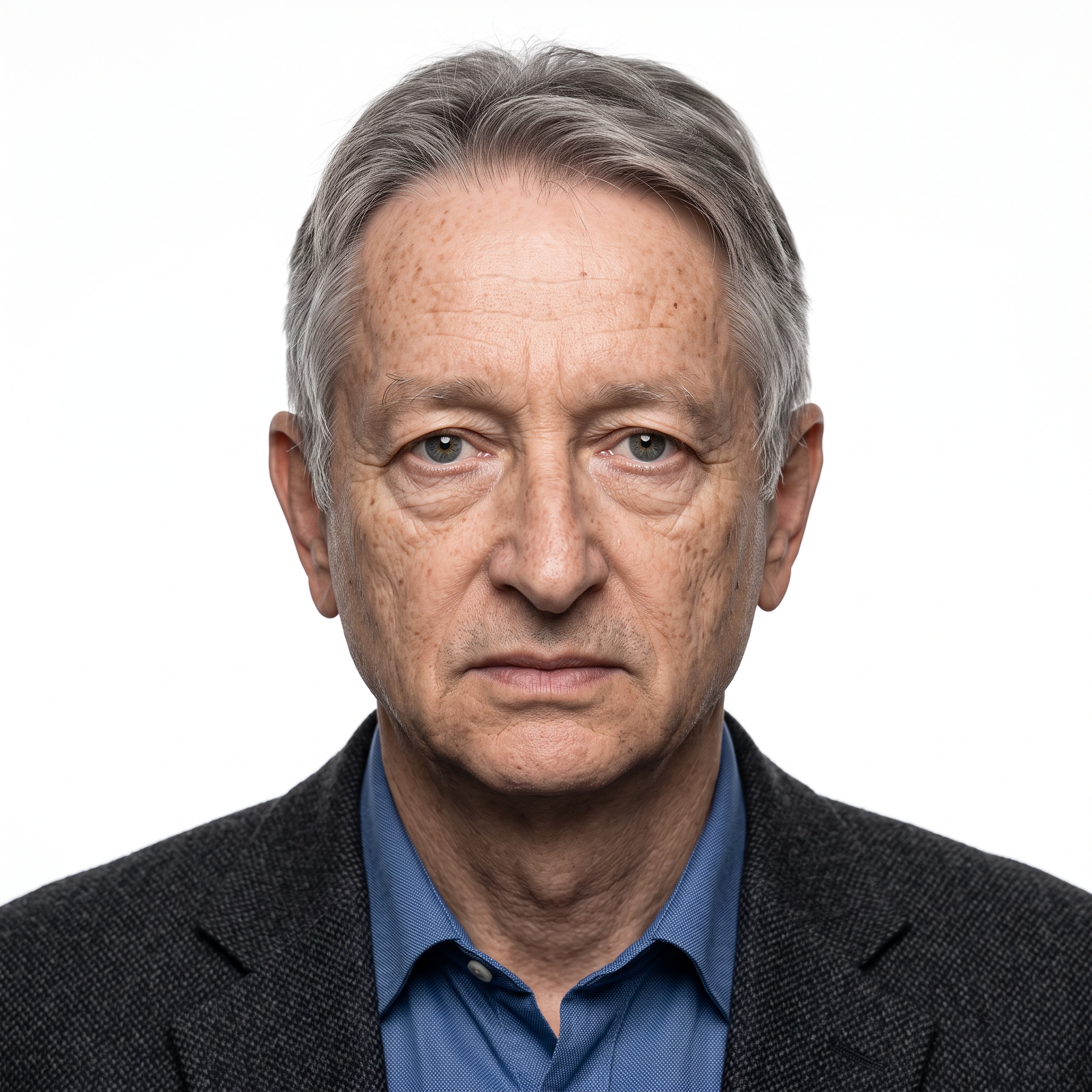
At a glance
- Born
- 1947 CE
- Era classification
- Modern
- Occupation
- Computer Scientist
- Homeland
- United Kingdom
- Period
- Late 20th – early 21st century
- Field
- Science & Innovation
- Language
- English
- Religion
- Atheism
- Gender
- male
Biography
Geoffrey Everest Hinton was born on December 6, 1947, in Wimbledon, London, into an accomplished family of scientists and mathematicians that included his great-great-grandfather, the logician George Boole. Hinton initially studied natural sciences, history of art, and philosophy at the University of Cambridge before graduating with a degree in experimental psychology in 1970. Driven by a desire to understand how the brain learns and computes, he pursued a doctorate in artificial intelligence at the University of Edinburgh under Christopher Longuet-Higgins, completing his thesis on neural networks in 1978 during a period when connectionism was largely marginalized by mainstream computer science.
Throughout the 1980s and 1990s, Hinton remained one of the few prominent researchers convinced that distributed representations and network-based learning algorithms could emulate human cognition. In 1986, alongside David Rumelhart and Ronald Williams, he co-authored a landmark paper that popularized the backpropagation algorithm for training multi-layer neural networks, providing the mathematical foundation for learning internal representations. Hinton also co-invented Boltzmann machines with Terry Sejnowski and subsequently introduced contrastive divergence to efficiently train restricted Boltzmann machines, establishing crucial techniques for unsupervised feature learning during prolonged 'AI winters.'
In 2012, working at the University of Toronto with his graduate students Alex Krizhevsky and Ilya Sutskever, Hinton demonstrated the profound capabilities of deep convolutional networks through AlexNet, which won the ImageNet computer vision competition by an unprecedented margin. This milestone catalyzed the modern deep learning revolution, leading Google to acquire their spin-off company, DNNresearch, and appoint Hinton as a vice president and engineering fellow. Hinton continued to conduct foundational research in neural architectures, representation learning, and capsule networks, while simultaneously mentoring many leaders of the emerging AI research community.
Hinton's enduring contributions to artificial intelligence earned him the ACM A.M. Turing Award in 2018 alongside Yoshua Bengio and Yann LeCun, as well as the Nobel Prize in Physics in 2024 shared with John Hopfield. In May 2023, Hinton resigned from his position at Google to freely voice his growing concerns regarding the existential risks, misuse, and rapid capability scaling of artificial general intelligence, shifting significant public and academic discourse toward AI safety and governance.
Portrayal characteristics
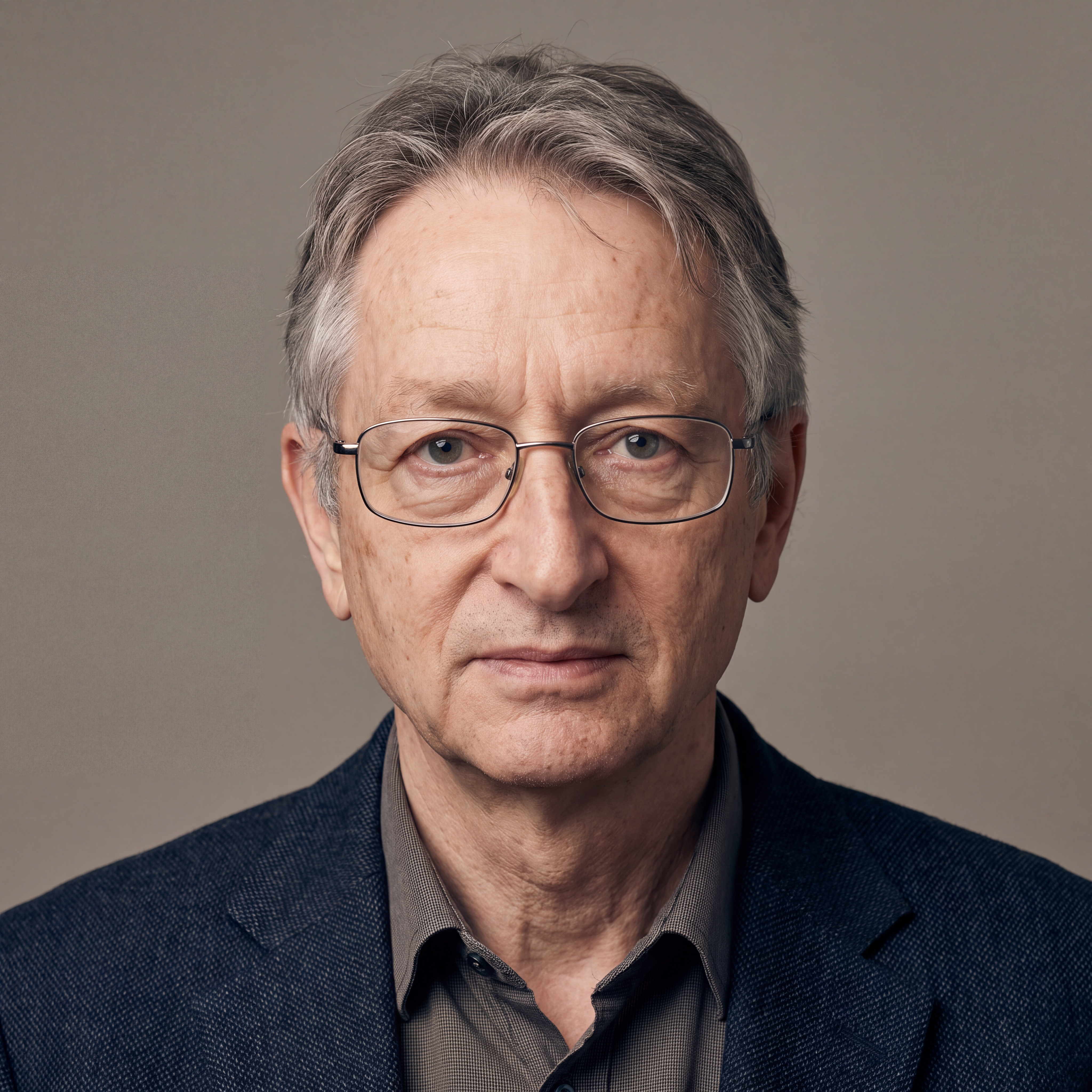
Saved editorial descriptions used for the reconstruction; these are not authenticated statements by the depicted person.
- Persistent
- Analytic
- Innovative
- Intellectually independent
- Conscientious
Images & artwork 2
Known for
- Popularization of the backpropagation algorithm
- Co-invention of Boltzmann machines and Restricted Boltzmann machines
- Breakthrough development of AlexNet and deep convolutional neural networks
- Recipient of the 2018 ACM A.M. Turing Award
- Recipient of the 2024 Nobel Prize in Physics
- Advocacy on artificial intelligence safety and governance
Episodes featuring or mentioning this figure
No eligible published episode featuring this figure is currently in the library.