



Erwin Schrödinger
Austrian physicist who revolutionized quantum theory with his wave equation and famous cat paradox.
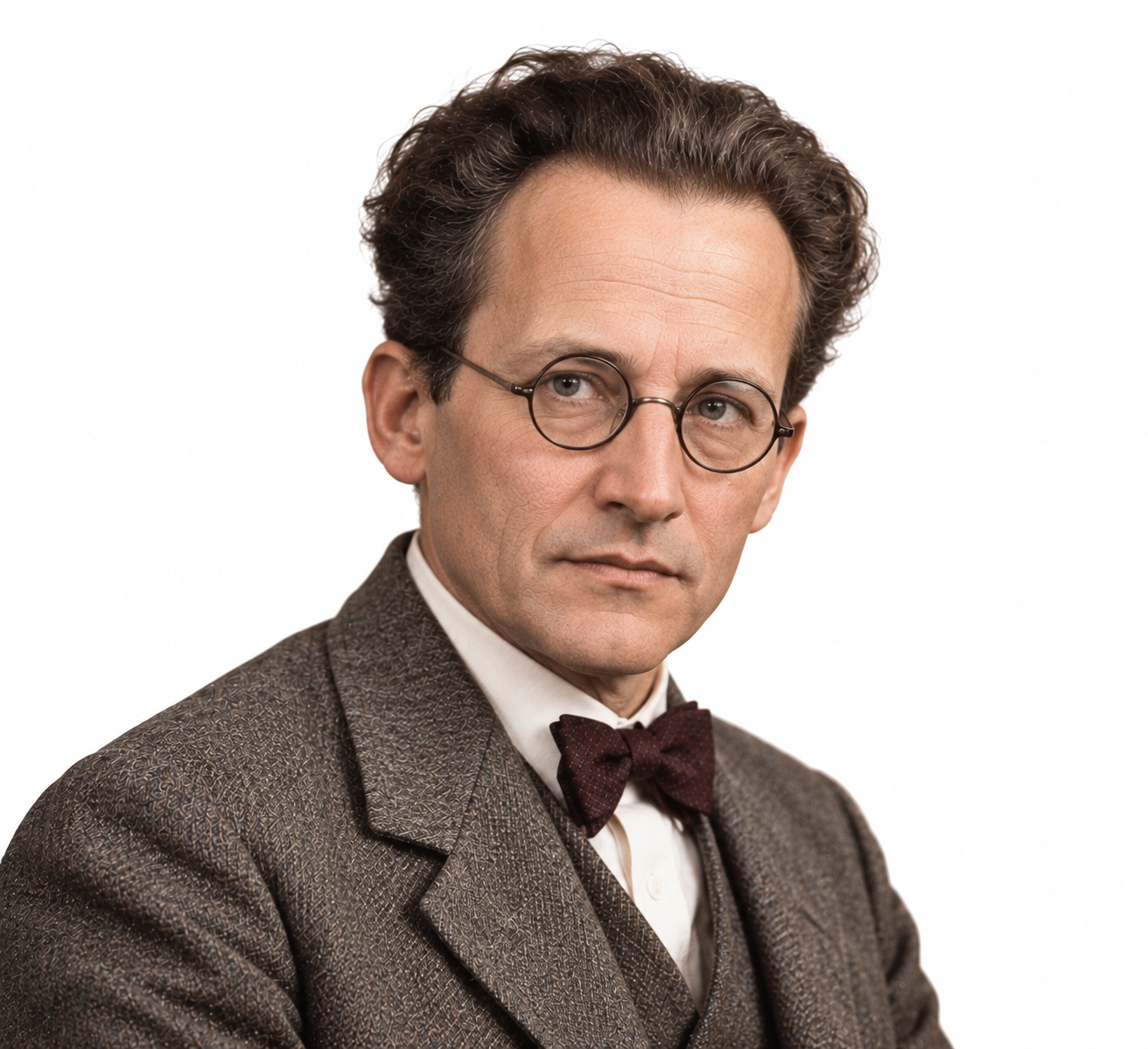
At a glance
- Born
- 1887 CE
- Died
- 1961 CE
- Era classification
- Modern
- Occupation
- Scientist (General)
- Homeland
- Austria
- Period
- Early to Mid-20th Century
- Field
- Science & Innovation
- Language
- German
- Religion
- Pantheism
- Gender
- male
Biography
Erwin Rudolf Josef Alexander Schrödinger was born in Vienna in 1887. Educated at the University of Vienna, he was deeply influenced by the analytical traditions of Ludwig Boltzmann and Friedrich Hasenöhrl. After serving as an artillery officer during World War I, Schrödinger pursued an academic career across several European universities, focusing on theoretical physics, thermodynamics, and the emerging puzzles of atomic structure.
In 1926, while working at the University of Zurich, Schrödinger achieved his monumental breakthrough by formulating wave mechanics. He introduced the Schrödinger equation, a fundamental differential equation that describes how the quantum state of a physical system changes over time. This work provided a powerful mathematical foundation for quantum mechanics and earned him the Nobel Prize in Physics in 1933, shared with Paul Dirac.
Schrödinger was an outspoken critic of the rising Nazi regime, leading him to leave Germany shortly after Hitler took power. He eventually settled in Ireland, where he helped establish the Dublin Institute for Advanced Studies. During the 1930s, he grew skeptical of the prevailing Copenhagen interpretation of quantum mechanics, famously formulating the "Schrödinger's cat" thought experiment in 1935 to illustrate the apparent absurdity of quantum superposition when applied to macroscopic objects.
Beyond physics, Schrödinger was a polymath with deep interests in philosophy, especially ancient Indian Vedanta, and biological sciences. His 1944 book, "What Is Life?", explored how physical laws apply to living organisms and introduced the concept of an aperiodic crystal storing genetic information, which directly inspired James Watson and Francis Crick in discovering the structure of DNA. Schrödinger returned to Vienna in 1956, where he lived until his death in 1961.
Portrayal characteristics
Saved editorial descriptions used for the reconstruction; these are not authenticated statements by the depicted person.
- Analytically brilliant
- Philosophically minded
- Unconventional
- Intellectually curious
- Interdisciplinary thinker
Images & artwork 1
Known for
- Schrödinger equation
- Schrödinger's cat thought experiment
- Foundations of wave mechanics
- 1933 Nobel Prize in Physics
- Seminal book 'What Is Life?'
Episodes featuring or mentioning this figure
No eligible published episode featuring this figure is currently in the library.