



Willy Brandt
West German Chancellor awarded the 1971 Nobel Peace Prize for his Ostpolitik reconciliation with the Eastern bloc.
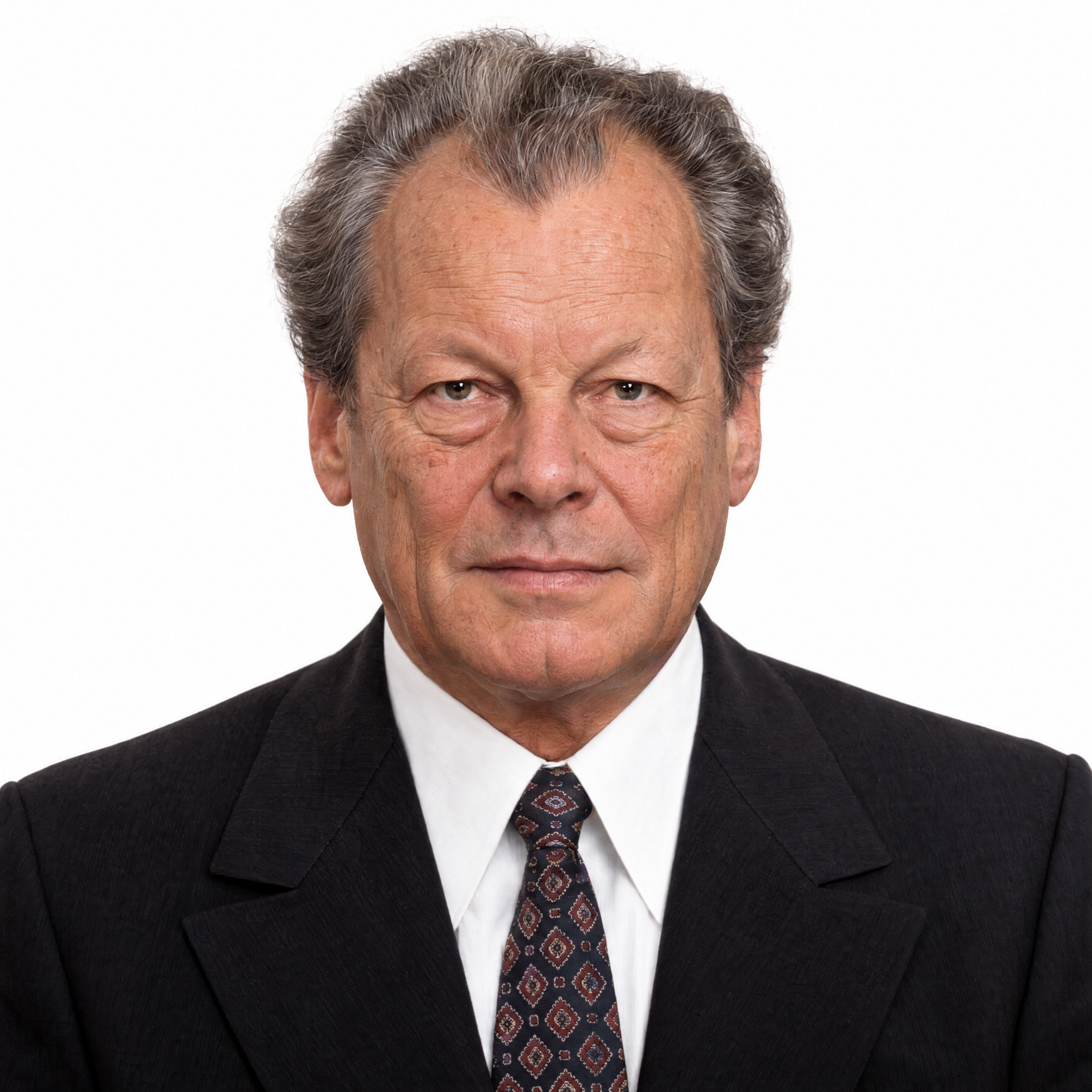
At a glance
- Born
- 1913 CE
- Died
- 1992 CE
- Era classification
- Modern
- Occupation
- Politician
- Homeland
- Germany
- Period
- Cold War
- Field
- Politics & Leadership
- Language
- German
- Religion
- Protestantism
- Gender
- male
Biography
Willy Brandt was born Herbert Ernst Karl Frahm in Lübeck, Germany, in 1913. An ardent anti-fascist and member of the Socialist Workers' Party of Germany, he fled the Nazi regime in 1933, seeking refuge in Norway and later Sweden. During his exile, he adopted the pseudonym Willy Brandt, which he later formalized, and engaged in journalism and resistance coordination while acquiring Norwegian citizenship.
Following the end of World War II, Brandt returned to Germany, regained German citizenship, and joined the Social Democratic Party (SPD). He gained international prominence as the Governing Mayor of West Berlin from 1957 to 1966, steering the city through the crisis surrounding the construction of the Berlin Wall in 1961. His steadfast leadership during this tense Cold War standoff established him as a premier statesman, leading to his appointment as Vice-Chancellor and Foreign Minister in Kurt Georg Kiesinger's Grand Coalition in 1966.
In 1969, Brandt became the first SPD Chancellor of the Federal Republic of Germany since 1930. His tenure was defined by Ostpolitik, an ambitious foreign policy seeking rapprochement and normalization of ties with the Soviet Union, Poland, Czechoslovakia, and East Germany. A poignant symbol of this effort occurred in December 1970 when Brandt fell to his knees before the monument to the Warsaw Ghetto Uprising, known as the Kniefall von Warschau, an act of humility acknowledging German war guilt. For his diplomatic efforts to ease East-West tensions, he was awarded the Nobel Peace Prize in 1971.
Brandt resigned the chancellorship in May 1974 following the revelation that his personal assistant, Günter Guillaume, was an East German intelligence operative. Despite leaving office, Brandt remained a towering political figure, leading the Socialist International from 1976 to 1992 and chairing the commission that produced the Brandt Reports on global development disparities between the North and South. He lived to witness the fall of the Berlin Wall and the early steps of German reunification before his death in 1992.
Portrayal characteristics
Saved editorial descriptions used for the reconstruction; these are not authenticated statements by the depicted person.
- Pragmatic
- Reconciliatory
- Resolute
- Charismatic
- Internationalist
Images & artwork 1
Known for
- Ostpolitik foreign policy
- 1971 Nobel Peace Prize
- Kniefall von Warschau
- Governing Mayor of West Berlin
- Chancellor of West Germany
Episodes featuring or mentioning this figure
No eligible published episode featuring this figure is currently in the library.