



Abu Bakr al-Razi (Rhazes)
Pioneering Persian physician and chemist celebrated for distinguishing smallpox from measles and advancing clinical care.

At a glance
- Born
- c. 865 CE
- Died
- c. 925 CE
- Era classification
- Medieval
- Occupation
- Doctor / Physician
- Homeland
- Rayy, Abbasid Caliphate (modern-day Iran)
- Period
- Islamic Golden Age
- Field
- Medicine & Natural Science
- Language
- Persian
- Religion
- Islam
- Gender
- male
Biography
Abu Bakr Muhammad ibn Zakariyya al-Razi, known to the Western world as Rhazes, was born around 865 CE in the city of Rayy, near modern-day Tehran. In his youth, he immersed himself in music, alchemy, and mathematics before turning his primary focus to medicine and philosophy in his thirties. He studied extensively in Baghdad, the vibrant intellectual capital of the Abbasid Caliphate, absorbing Greek, Persian, and Indian scientific traditions.
Al-Razi rose to become the chief physician of the royal hospital in Rayy and later headed the prestigious Muqtadari hospital in Baghdad. A dedicated clinician, he championed empirical observation over blind reliance on ancient authorities like Galen. He famously documented clinical case histories and pioneered early medical trial methodology, using control groups to test the efficacy of treatments. His landmark treatise on smallpox and measles provided the first clear clinical distinction between the two diseases, earning him enduring recognition as a founding father of pediatrics and infectious disease study.
Beyond medicine, al-Razi made profound contributions to alchemy and chemistry, transforming the discipline from esoteric mysticism into an empirical science. He developed laboratory equipment, classified chemical substances systematically, and is credited with the discovery and isolation of sulfuric acid and ethanol. His massive medical encyclopedia, 'Kitab al-Hawi' (The Comprehensive Book on Medicine), compiled his vast clinical observations and remained a standard reference text in European and Islamic universities for centuries.
In his later years, al-Razi's rationalist philosophy and unapologetic defense of reason often provoked controversy among theological traditionalists. He spent his final years back in Rayy, where progressive blindness, attributed to years of chemical experiments and cataract complications, impaired his vision. He passed away around 925 CE, leaving behind an extraordinary legacy of over two hundred scientific, medical, and philosophical works.
Portrayal characteristics
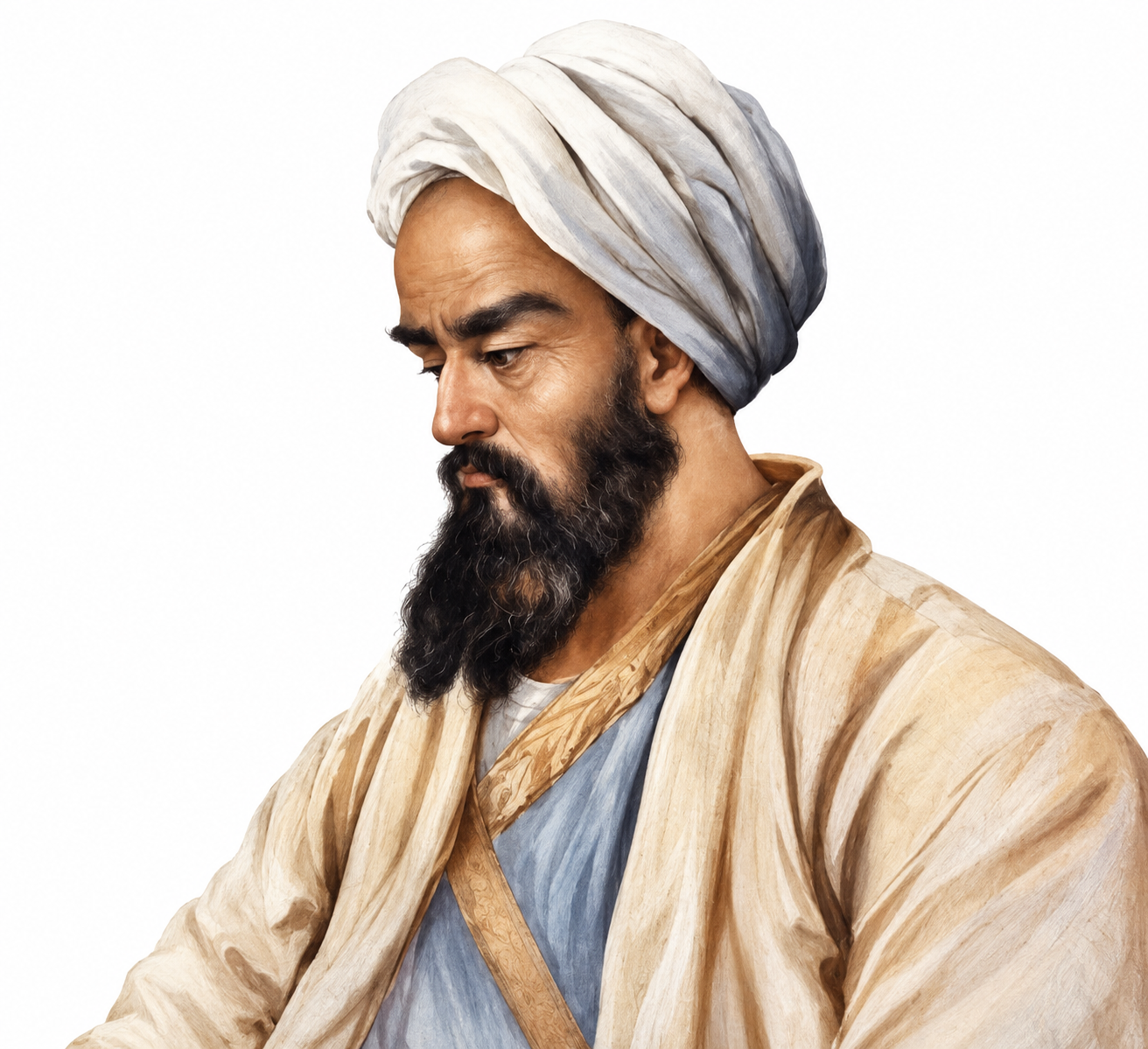
Saved editorial descriptions used for the reconstruction; these are not authenticated statements by the depicted person.
- Empirical
- Humanitarian
- Critical thinker
- Methodical
- Intellectually fearless
Images & artwork 6




Known for
- First clinical distinction between smallpox and measles
- Authoring 'Kitab al-Hawi' (The Comprehensive Book on Medicine)
- Pioneering medical experimental methods and clinical record-keeping
- Isolation and discovery of sulfuric acid and ethanol
- Serving as director of major hospitals in Rayy and Baghdad
Episodes featuring or mentioning this figure
No eligible published episode featuring this figure is currently in the library.