What makes history endure? | AI Jury: Ibn Khaldun, Fuat Köprülü, Ahmet Cevdet Paşa
- Publisher
- SiliconJury
- Language
- en · Localized adaptation
Topic
What determines a historian's enduring legacy—rigorous methodological discipline or a transformative intellectual character? In this debate, preeminent Turkish historians Halil İnalcık and İlber Ortaylı clash over whether historical truth is secured by systematic archival verification or illuminated by comparative synthesis and interpretive judgment.
AI RECONSTRUCTION
Those depicted did not participate in this production. Dialogue, voices, visual performances, and jury decisions were generated or interpretively reconstructed with AI. Unless explicitly identified and sourced, they are not authentic recordings, verified quotations, endorsements, or affiliations.
Editorial AI and representation policy (2026.08.29): https://www.siliconjury.com/en/policies/editorial-ai-representation
Halil İnalcık (Proponent)
İlber Ortaylı (Opponent)
Ibn Khaldun · Fuat Köprülü · Ahmet Cevdet Paşa
Halil İnalcık argues that a historian's lasting value rests fundamentally on source criticism, empirical rigor, and a transparent, testable methodology. Drawing on Ottoman tax registers (tahrir) and legal codes (kanunnames), he contends that while intellectual character may spark a hypothesis, only a disciplined, verifiable method transforms interpretation into collective, enduring knowledge that future generations can revise.
Conversely, İlber Ortaylı asserts that while empirical verification is indispensable, methodology alone cannot generate the vital questions that drive historical inquiry. Pointing to comparative frameworks and structural shifts like the transformation of Ottoman institutions, he argues that it is the historian's intellectual character, comparative horizon, and synthetic vision that rescue data from obscurity and give history its direction and public meaning.
The jury, featuring Arab sociologist Ibn Khaldun, pioneering Turkish historian Fuat Köprülü, and Ottoman statesman Ahmet Cevdet Paşa, was asked to weigh the historical evidence, conceptual consistency, and the ethical responsibility of historical knowledge.
SiliconJury brings together reconstructed historical minds to debate timeless questions of culture, methodology, and ethics, examining the intellectual frameworks that shape our understanding of the past.
CHAPTERS
- 0:00Introduction
- 0:10Round 1 — Halil İnalcık: I am Halil İnalcık
- 2:19Round 1 — İlber Ortaylı: My esteemed Professor, I fully concur…
- 4:39Round 2 — Halil İnalcık: Should two historians truly stand on…
- 6:09Round 2 — İlber Ortaylı: If a brilliant interpretation proves…
- 7:31Round 3 — Halil İnalcık: It is true that methodology cannot…
- 9:09Round 3 — İlber Ortaylı: Such criteria are essential for…
- 10:29Round 4 — Halil İnalcık: On the contrary, those two paradigms…
- 11:57Round 4 — İlber Ortaylı: The fact that the transformation…
- 13:07Round 5 — Halil İnalcık: Because the initial spark of discovery…
- 14:18Round 5 — İlber Ortaylı: Verification is an indispensable…
- 15:38Round 6 — Rebuttal — Halil İnalcık
- 17:09Round 6 — İlber Ortaylı: I concede this: intuition that fails…
- 18:31Round 7 — Halil İnalcık: The remedy is not an uncritical…
- 20:01Round 7 — İlber Ortaylı: My criterion is this: whenever…
- 21:27Round 8 — Halil İnalcık: Possessing identical scholarly…
- 22:45Round 8 — İlber Ortaylı: I do not elevate the continuity of a…
- 24:08Round 9 — Halil İnalcık: I grant that the scope of a question…
- 25:20Round 9 — İlber Ortaylı: The scholar who renders their evidence…
- 26:28Round 10 — Halil İnalcık: If two historians are truly equal not…
- 27:58Round 10 — Rebuttal — İlber Ortaylı
- 29:05Round 11 — Halil İnalcık: A singular methodological rule cannot…
- 30:33Round 11 — İlber Ortaylı: When an archive is lost and only one…
- 31:57Round 12 — Halil İnalcık: The reliable transmission of…
- 33:27Round 12 — İlber Ortaylı: If peers cannot retrace and test a…
- 34:51Jury — Ibn Khaldun
- 36:34Jury — Fuat Köprülü
- 38:02Jury — Ahmet Cevdet Paşa
https://www.siliconjury.com/en/policies/editorial-ai-representation
https://www.siliconjury.com/en/watch/58afdbfa-05d5-4910-9073-da65cf62e728
https://www.siliconjury.com/en/watch/58afdbfa-05d5-4910-9073-da65cf62e728
https://www.siliconjury.com/en/concerns
Our purpose is to create an accessible meeting point between new generations and intellectual legacies from which they may be growing increasingly distant; to preserve curiosity about these thinkers; and to encourage deeper, independent, and critical thought.
#SiliconJury #Halilİnalcık #İlberOrtaylı #Historiography
Available editions
Figure profiles named in this episode
Sources & references
Source references have not been supplied in this public edition record.
Published transcript
AI-assisted historical reconstruction
I am Halil İnalcık. My scholarly life has been shaped by a century of continuous
inquiry into Ottoman history—from my early formative years studying history and
geography at Ankara University’s Faculty of Language, History, and Geography
under master historians such as Fuat Köprülü, to decades immersed in the
Ottoman archival registers in Istanbul, and later years of teaching at the
University of Chicago and Bilkent University. This enduring trajectory
taught me that the historian’s task does not end with the raw accumulation of
evidence; one must attend not only to what documents explicitly state, but also
interrogate their deliberate silences and omissions through rigorous source
criticism. In this discourse, by 'historical knowledge' I denote an
intimate mastery of primary sources, languages, and the mentalité of an epoch.
By 'methodological discipline', I mean rigorous source criticism, the
comparative scrutiny of evidence, and the construction of an argument subject to
intersubjective verification. 'Intellectual character', to my mind, is
neither personal charisma nor public renown; it is the historian’s capacity for
formulating profound questions, conceptualizing problems, and defining a
distinct perspective. We must meticulously demarcate direct archival evidence
from our own speculative inferences—a boundary ever more critical today, when
subjective conjecture so readily masquerades as historical knowledge.
Professor Ortaylı, how can one truly discern a historian's intellectual
character apart from the erudition and methodological rigor that underpin it?
My esteemed Professor, I fully concur with your fundamental premise: a historian
must discern both the explicit testimony of documents and the chasms of their
unsaid. My own intellectual path was forged at the crossroads of diverse
imperial and cultural worlds—from being born in Bregenz, Austria, to a Crimean
Tatar family, to studying political science and history at the universities of
Ankara and Vienna, having the distinct honor of being your student at Chicago,
and later serving as the President of the Topkapı Palace Museum. This journey
compelled me to read Ottoman history not as an isolated island, but in
comparative dialogue with the Habsburg and Russian empires, and through the
intersecting prisms of jurisprudence, administration, urban topography,
philology, and geography. My position is equally unambiguous: intellectual
character cannot be conceived in isolation from historical knowledge and
methodology. Historical knowledge is the deep comprehension of sources and their
context; methodology is the appraisal of evidential validity and the
articulation of interpretive logic. Yet intellectual character introduces an
indispensable dimension: the autonomous capacity to select, synthesize, and
comparatively evaluate evidence. This character is neither vanity nor
superficial intellectualism; it is the discerning faculty that extracts genuine
historical problems from an ocean of data. In an era where any opinion can
assume the veneer of scholarship, this distinction is paramount. My question to
you is this: if two historians possess equivalent erudition and identical
methodology, what explains why the work of one endures while the other fades
into obscurity?
Should two historians truly stand on equal footing regarding knowledge and
methodology, their divergence must indeed be sought in their power of
conceptualization and synthesis—namely, their intellectual character. However,
our dispute does not concern whether intellectual character matters, but rather
which pillar carries the decisive weight in establishing enduring scholarly
value. My contention is straightforward: intellectual character charts the
trajectory, but rigorous knowledge and methodology determine whether that
trajectory is resilient, verifiable, and lasting. For instance, characterizing
the Ottoman timar system—the assignment of agricultural revenues in return for
military service—merely with the seductive label of 'military feudalism' may
stimulate the intellect. Yet, only by collating tax registers (tahrir), legal
codes (kanunnames), assigned revenue amounts, peasant obligations, and regional
variations can one determine where the analogy holds and where it collapses.
Such an analysis invites peer scrutiny, refinement, and expansion via newly
unearthed documentation. Intellectual character endows a work with originality;
methodology transforms it into collective knowledge. When a brilliant
interpretation defies falsification and ultimately proves untenable, what
remains of its scholarly worth?
If a brilliant interpretation proves erroneous, it rightly forfeits its
scholarly validity; on that point, we are in complete agreement. Yet it does not
follow that erudition and methodology are the sole decisive factors. They can
unmask error, but they cannot inherently tell us which questions are worth
pursuing in the first place. Consider the Provincial Law of 1864: one can read
it with meticulous paleographic precision, reconstruct council structures, and
enumerate the duties of local officials. This is necessary and commendable work.
However, enduring historiography commences only when we ask: How did these
reforms restructure center-periphery dynamics? Why did they yield disparate
outcomes across diverse imperial frontiers? And in comparative perspective
with the Habsburg or Russian empires, what constituted the distinctive hallmark
of the Ottoman experience? Documents do not deliver these questions prepackaged.
It is the comparative horizon and interpretive judgment of the historian
that forges them. Method renders a work reliable; intellectual character confers
upon it historical direction and significance. By what internal metric can
methodology alone determine which questions merit inquiry?
It is true that methodology cannot mechanically select the vital question.
Yet the epistemic value of a question is measured precisely by its capacity to
resolve contradictions within evidence and its susceptibility to testing across
diverse settings. The very example you cite regarding the 1864 Provincial Law
demonstrates this. Reading the statutory text in isolation does not constitute
comprehensive historical knowledge; it is merely the point of departure. When
cross-referenced with the implementation in the Danube Province, municipal
records, official yearbooks (salnâmes), central-provincial correspondence, and
divergent regional outcomes, the central historical problem crystallizes: why
did a unified juridical framework produce radically divergent realities across
regional landscapes? Your comparative horizon is invaluable, yet it elevates
into sound historical judgment only when regional distinctions are empirically
grounded and concepts evaluated within their authentic temporal context.
Otherwise, comparisons with Russia or the Habsburgs risk deteriorating into
arbitrary, albeit eloquent, analogies. If we surrender the selection of
questions entirely to individual intellectual character, by what objective
standard do we prune futile or anachronistic inquiries?
Such criteria are essential for discarding fallacious questions, but they do not
spontaneously generate generative ones. Method can expose anachronisms and flag
discordant evidence; however, the historical significance of a problem
emerges only when it bridges phenomena previously viewed as disjointed. Observe
Ottoman historiography: the classical 'decline paradigm' endured for decades
despite an abundance of scrupulously transcribed records. Institutional shifts
were invariably diagnosed as symptoms of decay. A transformative paradigm arose
only when historians posed a fundamentally new question: might these
transformations represent mechanisms of pragmatic adaptation, fiscal
negotiation, and the recalibration of power rather than inexorable collapse? The
documents were vital, but the shift was not merely in the archival corpus; it
was the historian's conceptual horizon that evolved. Methodology can delimit the
scope of invalid answers, yet it cannot unlock novel paradigms of historical
explanation. If comparable source discipline can sustain both the decline
thesis and the transformation thesis, what accounts for the decisive
breakthrough if not the power of historical judgment?
On the contrary, those two paradigms did not employ identical methodologies. The
decline narrative routinely took the grievances in mirror-for-princes treatises
(nasihatnames) as literal descriptions of institutional reality, measuring them
against an idealized past. The transformation approach contextualized
those very texts within their literary genre and political rhetoric,
cross-examining them against fiscal rolls, court records (sharia court
registers), and provincial administrative correspondence. Consequently, the
contraction of the timar or the proliferation of tax farming (iltizam) was
no longer seen merely as moral decay, but as structural responses to treasury
cash requirements, warfare expenditures, and power negotiations with provincial
notables. Thus, the new horizon did not stem merely from a shift in taste or
intuition; the method of reading, contextualizing, and synthesizing evidence
underwent a fundamental evolution. It was this methodological rigorousness that
redefined the relationship among sources. If intellectual character is the sole
determinant, why did the transformation paradigm achieve permanence only when
the corpus of sources and their critical appraisal were substantially expanded?
The fact that the transformation paradigm was solidified through broader sources
and rigorous method demonstrates that method served to test and validate the
thesis, not that method autonomously conceived it. You are conflating the
genesis of an interpretive framework with the apparatus used to verify it. Take
the malikâne system instituted in 1695: one can reconstruct fiscal ledgers entry
by entry. Yet those ledgers do not inherently reveal how the life-term
privatization of revenue collection intertwined the tax farmer's long-term
interest with the state, forged provincial centers of authority, or shared
structural parallels with financial intermediaries in early modern Europe. It
is the historian's intellect that discerns these systemic configurations and
distinguishes structural shifts from incidental phenomena. New documents can
strengthen or dismantle a narrative; but first, a mind must grasp which archives
to integrate and to what end. Why elevate the instrument of verification above
the intellectual faculty that determines the trajectory of explanation?
Because the initial spark of discovery is not synonymous with what guarantees
its enduring validity. Intellectual character may ignite the hypothesis; our
central inquiry, however, concerns why a historical judgment withstands the
erosive test of time. Regarding the malikâne, until central treasury auctions,
down payments (muaccele), annual installments (müeccele), litigations
recorded in court registers, and the role of local intermediaries are
systematically collated, the claim of 'aligned interests between contractor and
crown' remains an untested hypothesis. Furthermore, a vital legal distinction
must be upheld: the malikâne did not alienate land ownership; it conferred
merely the usufructuary right to collect specified revenues. This precise legal
reality curtails sweeping, misleading analogies. Institutions do not simply
generate documentation; they delimit the authority and incentives of actors. If
the rigorous evaluation of fiscal and juridical evidence does not arbitrate
between two competing creative interpretations, what shared objective
standard remains for scholarly consensus?
Verification is an indispensable prerequisite, yet it is not the exhaustive
definition of enduring historiographical worth. I readily grant the necessity of
distinguishing land tenure from revenue collection in the malikâne.
Nevertheless, institutions themselves predetermined what was inscribed, where it
was preserved, and what knowledge was rendered accessible for scrutiny. A
document drafted by the central treasury resides in one archival classification;
local court registers belong to an entirely different corpus. Academia,
historical societies, publishers, and curricula similarly elevate certain
questions while marginalizing others. The enduring historian does not merely
decipher extant records with technical accuracy; they transcend institutional
compartmentalization to synthesize jurisprudence, fiscality, and provincial
power into a coherent whole. This is not personal vanity; it is intellectual
responsibility and synthetic vision. If archives and academic institutions
pre-structure the evidential field, does not the exclusive glorification of
verification risk treating these institutional biases as neutral reality?
No; on the contrary, authentic methodological discipline is precisely
what exposes the non-neutrality of the archive. Source criticism is far more
than distinguishing genuine from forged manuscripts; it requires understanding
which institution produced the document, in what language, under which
classification, and toward what political end. The Mühimme registers reflect the
sovereign decrees of the Imperial Council; the Ahkâm registers trace the
bureaucratic resolution of petitions; and waqf accounting rolls map the
circulation of endowments and wealth. None of these in isolation represents the
totality of society. Today as well, state archives, libraries, academic
societies, and publishers condition the circulation of knowledge. For this
reason, methodological rigor obliges the historian to illuminate the entire
chain of production, classification, preservation, and dissemination,
calibrating disparate collections against one another and interpreting archival
silences with scholarly caution. Intellectual character may intuit these
fissures; but unless it articulates a transparent, testable framework for
others, how can we be certain it has not merely reproduced the parochial tastes
of its own academic milieu?
I concede this: intuition that fails to translate into a verifiable methodology
often merely echoes the conventions of its immediate environment. Yet
methodology is not conceived in an abstract vacuum. Institutions determine
which languages are taught, which archival collections receive funding, and
which dossiers are opened to scholarly access. A historian who conceptualizes
Ottoman institutions solely through central state records does not share the
horizon of one who integrates waqf deeds, sharia court registers, and the
archives of Venice and the Habsburgs into a single dialogue. Transcending these
boundaries does not violate methodology; it expands method through independent
judgment. A seminal work derives its enduring power precisely from this
rupture: the historian disrupts established academic divisions of labor
and orchestrates a dialogue among disparate, traditionally segregated
sources. If institutional structures have pre-limited the parameters of
comparison, on what basis can we proclaim the method sanctioned by that very
order to be unequivocally superior to independent intellectual character?
The remedy is not an uncritical submission to institutionalized methods, but the
rigorous, critical deployment of method to interrogate institutional boundaries
themselves. The scholarship of Ömer Lütfi Barkan serves as a paramount exemplar.
He juxtaposed cadastral tax registers (tahrir) with narrative dynastic
chronicles, dismantling the conventional academic division of labor. Yet the
permanence of his legacy did not stem solely from the bold nature of this
choice; Barkan systematically correlated demographic data, household units,
agrarian holdings, and tax assessments with statutory legal codes, tracing these
structures across regions and centuries. Thus, the relationship between the
Ottoman peasantry and the state was elevated into a verifiable scientific
inquiry. Subsequent scholars could refine his conclusions using sharia court
records and endowment registers precisely because his methodological path was
transparent. Intellectual character expands the horizon of sources, but
methodology transforms that expansion into collective knowledge. What objective
metric do you offer to disentangle the enduring contribution of autonomous
judgment from that of a testable methodology?
My criterion is this: whenever specific empirical findings of a study are
revised, yet the conceptual problem and comparative horizon it established
continue to generate vital new research, we are witnessing something that
transcends mere technique; we are witnessing intellectual character. Fuat
Köprülü is the quintessential embodiment of this principle. He did not extract
the genesis of the Ottoman state exclusively from dynastic chronicles. He
synthesized marchland societies, dervish networks, Anatolian Turkish legal
traditions, literary corpora, and the institutional practices of neighboring
civilizations. Subsequent scholarship modified several of his specific
contentions, yet the horizon he inaugurated remains permanent: Ottoman
institutions were neither simple replications of Byzantium nor isolated
anomalies. Method rendered his arguments open to scholarly verification; but it
was his discerning judgment that recognized which disparate worlds demanded
comparison. If contemporary historians possessed identical archival tools yet
failed to formulate such a synthesis, why should we attribute the definitive
cause of enduring relevance to the instruments rather than to the synthetic
intellect of the historian?
Possessing identical scholarly instruments by no means implies possessing
equivalent cumulative erudition or comparative rigor. Köprülü is a formidable
example, and none would dispute his genius in formulating historical questions;
yet his rebuttal of the Byzantine thesis did not arise from unmediated
intuition. He commanded an extraordinary mastery of Islamic and Turkic
jurisprudence, philology, sufi networks, and the Seljuk and Beylik institutional
substrates. Subsequent scholars were able to refine his judgments precisely
because he made his comparative sources and inferential steps entirely
transparent. A historian may indeed steer the agenda of a generation even on the
back of flawed conclusions; that is intellectual influence, but not every form
of influence equates to enduring scholarly validity. What keeps the domain
Köprülü opened vibrant is both the audacity of his horizon and the
methodological transparency that preserved the possibility of revision. Why do
you prioritize the perpetuation of a thematic field over the scientific
validity of the conclusions generated within it?
I do not elevate the continuity of a field above the veracity of its
conclusions; my argument is that the enduring value of a historian cannot be
reduced to the sum total of their correct answers. At times, a critical edition
of a text or an exhaustive catalogue remains indispensable for centuries, even
if the editor's interpretations are long forgotten. The 'Monumenta Germaniae
Historica' stands as a luminous monument to such an endeavor. Yet what survives
in that instance is scholarly infrastructure, not the full measure of a
historian's intellectual legacy. The obverse is equally clear: if source
criticism is defective, the most magnificent historical narrative
inevitably degenerates into mere literature. Hence, I do not discard
knowledge and method; they are the framework that sustains the work. Yet it
is autonomous judgment that confers historical direction and social meaning
upon it. If factual accuracy and revisability were the sole arbiters, why
is it that among works of equal archival solidity, some inspire groundbreaking
comparative horizons while others remain merely reference manuals?
I grant that the scope of a question and the power of synthesis render certain
works profoundly generative, and that this vitality belongs to the historian's
intellectual character. Yet this does not permit the conclusion that
intellectual character holds the superior weight in scholarly longevity. Imagine
a future computational system that processes millions of Ottoman records,
constructing a brilliant narrative of center-periphery relations, yet cloaking
its citations, paleographical discrepancies, and inferential chain in
opacity. Conversely, imagine an equally creative historian who renders that
entire methodological process transparent. The former might trigger ephemeral
fascination; but only the latter permits future generations to test the thesis,
calibrate it against newly discovered registers, and integrate it into
collective scholarship. In the digital era, the abundance of data does not
diminish the imperative for methodological discipline; it magnifies it
exponentially. Between two equally creative interpretations, which possesses
enduring historical value: the one that obscures its evidential trail, or the
one that keeps it open to scrutiny?
The scholar who renders their evidence and interpretive path transparent
unquestionably possesses more enduring scholarly value; obfuscating method
constitutes both technical malpractice and intellectual dereliction. Yet your
comparison assumes an asymmetry from the outset: one party is methodologically
flawed. The far more formidable challenge of the future is that automated
systems may effortlessly provide exact citations, variant readings, and explicit
deductive chains. Even then, the critical imperative remains: determining
whether administrative rubrics in official salnâmes can be commensurated with
the sociological descriptions in consular dispatches, and discerning which
correlations possess authentic historical significance. Data saturation does not
alleviate the need for interpretive judgment; it multiplies spurious
correlations. If two future historians present their evidential architecture
with identical transparency and precision, how can methodological discipline
alone explain why one historical synthesis endures while the other is forgotten?
If two historians are truly equal not merely in documentation, but in
conceptualization, comparative framing, falsifiability, and the calibration of
uncertainty, then indeed, the variance in their longevity is explained by
synthetic capacity and intellectual character. But to establish the supremacy
of intellectual character, you have excised all methodological distinctions
from your premise. Transparency is merely one dimension of methodology. A system
may document every citation; yet if it treats a bureaucratic category in a
salnâme as equivalent to a sociological observation in a consular dispatch, it
commits a methodological error. The former reflects sovereign institutional
logic; the latter, the subjective perspective of an observer. Enduring
scholarship must disentangle the institutional purpose of these taxonomies,
delineate the limits of comparison, and stress-test the model against
counter-classifications. In the digital age, method does not disappear; it
shifts from archival retrieval to the critical oversight of models and concepts.
When you presuppose these processes to be equal, have you not embedded your
desired conclusion directly into your premises?
No; the assumption of parity is necessary precisely to test which factor serves
as the ultimate determinant. Distinguishing salnâme rhetoric from
consular accounts is undoubtedly methodological; yet multiple competing
models may simultaneously possess methodological validity. Suppose a system
correctly accounts for the fact that the 1831 census concentrated primarily on
the male population, while temettuat registers documented household assets and
revenues for an entirely different fiscal purpose. Even then, the raw data
cannot dictate which interpretive axis holds greater explanatory power:
demography, fiscal capacity, or household structures. Furthermore, if
institutional grants reward solely data-dense projects, well-documented
metropolitan centers are amplified, while archival-poor peripheries are once
again excised from history. Independent judgment is not the antagonist of
methodology; it is the responsible choice among competing valid methods. If
several equally rigorous models yield fundamentally divergent narratives of the
past, what rigid methodological rule can autonomously dictate priority?
A singular methodological rule cannot dictate an absolute priority among
demography, fiscality, and familial structures. That choice depends on the
historian's question and intellectual character; yet defending the rationale of
that choice, testing alternative models, and identifying excluded groups remain
part of methodological discipline. Thus far, we agree: method is not mechanical,
institutions can constrain it, and intellectual character formulates the
problem. Our divergence lies solely in their relative weight regarding enduring
value. Now consider my strongest counter-example: two historians of equal
intellectual creativity examine the identical archival collection. Years
later, the original archive is destroyed in a catastrophe. The first historian
published their sampling method, paleographical criteria, and anomalous
entries; the second left only their brilliant synthesis. The first historian’s
conclusions remain perpetually open to re-examination; the second survives
solely by the authority of the author's name. If their intellectual character
was equal, yet the knowledge transmitted to posterity is not, why should we
identify the primary engine of longevity in intellectual character rather than
methodology?
When an archive is lost and only one scholar documented their sampling and
reading criteria, their methodologies are no longer equal. That scenario
demonstrates the necessity of a baseline methodological standard, not that this
baseline constitutes the primary catalyst of enduring historical greatness. My
synthesis is clear: without empirical information, judgment cannot form; without
method, collective knowledge cannot crystallize; and without intellectual
character, questions, comparative vision, and public significance cannot emerge.
Our debate concerns the relationship between the 'indispensable foundation' and
the 'direction' constructed upon it. Envision two historians publishing a
multilingual urban archive with identical transparency. One arranges the
documents merely as the footsteps of modern nation-building. The other
interrogates courts, municipalities, and migration patterns to ask how
long-standing orders of coexistence disintegrated. Data and transparency are
equal in both; yet the second framework opens profound new inquiries in
jurisprudence, urban history, and sociology. Why should we deem the
mechanism that guarantees reliable transmission superior to the intellectual
force that determines the historical direction of that knowledge?
The reliable transmission of knowledge is not merely a technical baseline; it is
the fundamental precondition that empowers future generations to alter the
course of historiography. I acknowledge the salient strength of your argument:
intellectual character selects the question, bridges disparate institutions,
and infuses research with public resonance. Yet when you presuppose two
analytical frameworks to be 'equally robust', you take their enduring value for
granted from the outset. History is dynamic: future excavations reveal new
records from courts, municipalities, and petitions. A study whose evidential
boundaries and inferential steps are lucidly demarcated can be tested and
revised; an opaque work, no matter how brilliant, remains tethered solely to the
personal authority of its author. Method does not merely preserve knowledge; it
organizes the very mechanism of intergenerational revision. Knowledge
grounds judgment in its context; method exposes it to collective scrutiny; and
intellectual character imparts direction. My esteemed colleague, if peers cannot
verify the path a historian has opened, what endures in history: a living
scholarly legacy, or merely the authority of a name?
If peers cannot retrace and test a historian’s pathway, what remains is not
enduring history, but personal authority. That is your most formidable point,
and I accept it without reservation. It is the transparent chain of sources that
enables future generations to revise earlier judgments upon the discovery of
new evidence. Yet revisability alone cannot explain which questions possess
such intrinsic weight that subsequent generations return to them across
centuries. Marc Bloch's comparative analysis of feudal society, despite
ongoing debates regarding his specific findings, bequeathed an analytical
vocabulary that liberated European studies from parochial national frameworks.
Here lies the mechanism of longevity forged by intellectual character: it
anchors robust knowledge to new geographies, neighboring disciplines, and
the inquiries of future generations. Knowledge sustains judgment, and method
submits it to critical evaluation; yet selection, comparison, and public
responsibility endow it with life and trajectory. A historian does not survive
merely through correct answers, but through the enduring questions they
bequeath to posterity.
I am Ibn Khaldun. History in my conception is not merely the transmission of
chronicles; it is the discernment of the fundamental laws governing human
society, civilization ('umran), and the causal nexus underlying historical
events. The crux of this debate was clear: does the enduring validity of
historical truth depend primarily upon a verifiable chain of evidence and
methodology, or upon the intellectual horizon that transforms empirical data
into a meaningful problem? Debater A (Halil İnalcık), with precise examples
from cadastral registers, the timar, the malikâne, and state fiscal mechanisms,
demonstrated that historical judgment becomes collective knowledge only when it
is falsifiable, subject to critique, and open to intergenerational revision.
Debater B (İlber Ortaylı) rightly demonstrated that methodology alone cannot
formulate generative questions, and that without interpretive judgment, a
mountain of archival documents reduces to an inert chronicle. Both debaters
occasionally severed method and intellectual character too starkly. A
brilliant mind without evidential rigor dissolves into speculation; methodology
without causal inquiry devolves into pedantry. Nonetheless, because the debate
centered on 'enduring value', Debater A's arguments regarding testability,
transparency, and intergenerational revisability carried greater weight. My
ruling, by a narrow margin, is awarded to Debater A.
I am Fuat Köprülü. In evaluating this debate, I look above all to conceptual
consistency, the logical coherence of argument, and the capacity of each side to
unite empirical sources with an expansive historical horizon. The principal
divide lay between two perspectives: Debater A conceived methodology as a
communal guarantee for the verification and revision of knowledge; Debater B
championed intellectual character as the generative force that identifies the
problem and bridges disparate fields. Debater A offered a structured and
historically solid defense through the work of Ömer Lütfi Barkan, cadastral
registers, and the necessity of revisability. Debater B, citing my own
scholarship and subsequently Marc Bloch, cogently illustrated that method alone
cannot determine which cultural spheres require comparison or which questions
will enrich future generations. Yet method and intellectual character are not
antithetical poles. Without philological mastery, source criticism, and
disciplined comparison, intellectual character lapses into fantasy; without
synthetic vision, methodology degenerates into myopic technique. Debater B
opened wider horizons; yet Debater A more convincingly proved that an innovative
idea becomes an enduring scholarly legacy only through transparency and
revisability. My verdict, by a narrow margin, goes to Debater A.
I am Ahmet Cevdet Pasha; I have written history, served in the highest
statecraft, and presided over the codification of the Mecelle-i Ahkâm-ı
Adliye. I assess this debate through the lens of the public responsibility of
knowledge, political wisdom, and the ethics of judgment. The fundamental
inquiry was whether enduring historiography rests upon a systematic,
verifiable methodology or upon an intellectual character that provides
society with direction and meaning. Debater A, drawing upon cadastral
registers, statutory codes, and intergenerational revisability,
demonstrated that historical evidence becomes public knowledge only when the
inferential chain is transparent and open to re-examination. Debater B, through
the example of Köprülü and the principle of responsible choice among valid
methodologies, rightly reminded us that method alone does not generate
historical insight or moral direction. Yet the discipline of history is neither
mere archival scribing nor an exhibition of intellectual virtuosity. Its calling
is to unite fidelity in evidence with justice in judgment and an awareness of
civic consequences. Debater B was profoundly eloquent regarding intellectual
responsibility and opening horizons; nevertheless, Debater A more convincingly
proved that public responsibility cannot survive without the verifiability and
accountability of claims. My ruling, by a modest margin, favors Debater A.
Related episodes
Conscience and the superweapon
A preserved SiliconJury audiovisual production. Original written metadata and transcript are not verified against this historical file.

Mahmoud Hessabi vs Albert Einstein: Nuclear Access and Scientific Sovereignty
AI jury: 3 members
Should developing nations have unrestricted access to peaceful nuclear technology, or do the attendant geopolitical and safety risks demand strict limits?

Does Technology Make Us More Free? Alan Turing vs Hannah Arendt
Does technological progress expand the horizon of human freedom, or does it merely perfect the machinery of administrative control?
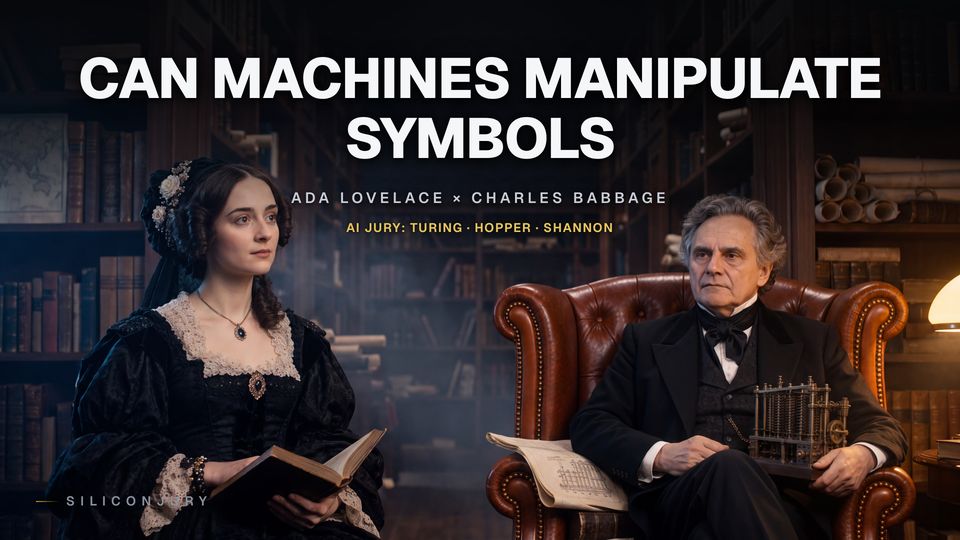
Ada Lovelace vs Charles Babbage: Calculating Numbers or Weaving Symbols?
AI jury: 3 members
Was the Analytical Engine conceived merely to automate numerical calculations for printed mathematical tables, or did it establish the foundational principles of universal…

The Architecture of Electrical Power: Edison vs Tesla
AI jury: 3 members
Does the future of electrical infrastructure belong to localized direct-current microgrids or vast, interconnected alternating-current networks?