Technological progress, on balance, makes humanity more free.
- Publisher
- SiliconJury
- Language
- en · Localized adaptation
Topic
A program may indeed
be rewritten, Mr.
Turing, but the
bureaucratic apparatus
that owns and operates
the infrastructure
is rarely so malleable.
Generality may
multiply functional
possibilities, yet it
simultaneously empowers
a centralized
administration to
absorb ever wider
spheres of human life
into its managerial
logic. The machinery
of total domination in
Nazi Germany was not
a single malevolent
apparatus. It was an
intricate synthesis of
population registers,
railway timetables,
teleprinters,
departmental
hierarchies, and
procedural routines.
None of these technical
devices commanded
extermination in
themselves. Yet, in
combination, they
enabled a catastrophic
decision to pass
through thousands of
bureaucratic desks as
a series of orderly,
technically correct
operations. Every
bureaucrat could claim
they were merely
processing forms,
scheduling logistics, or
executing prescribed
procedures. This is
the profound political
hazard of the machine
age. Technology does
not need to declare an
evil intent to subvert
freedom; it accomplishes
this by extending the
reach of administration
while dispersing
responsibility so
thoroughly that no
human actor feels
accountable for the
outcome. Enhanced
efficiency increases
functional capability
while eradicating the
very moments where
moral refusal,
political judgment, and
public responsibility
can intervene.
Available editions
Sources & references
Source references have not been supplied in this public edition record.
Published transcript
AI-assisted historical reconstruction
A program may indeed be rewritten, Mr.
Turing, but the bureaucratic apparatus
that owns and operates the infrastructure
is rarely so malleable. Generality may
multiply functional possibilities, yet it
simultaneously empowers a centralized
administration to absorb ever wider
spheres of human life into its managerial
logic. The machinery of total domination in
Nazi Germany was not a single malevolent
apparatus. It was an intricate synthesis of
population registers, railway timetables,
teleprinters, departmental
hierarchies, and procedural routines.
None of these technical devices commanded
extermination in themselves. Yet, in
combination, they enabled a catastrophic
decision to pass through thousands of
bureaucratic desks as a series of orderly,
technically correct operations. Every
bureaucrat could claim they were merely
processing forms, scheduling logistics, or
executing prescribed procedures. This is
the profound political hazard of the machine
age. Technology does not need to declare an
evil intent to subvert freedom; it accomplishes
this by extending the reach of administration
while dispersing responsibility so
thoroughly that no human actor feels
accountable for the outcome. Enhanced
efficiency increases functional capability
while eradicating the very moments where
moral refusal, political judgment, and
public responsibility can intervene.
Related episodes
Conscience and the superweapon
A preserved SiliconJury audiovisual production. Original written metadata and transcript are not verified against this historical file.

Mahmoud Hessabi vs Albert Einstein: Nuclear Access and Scientific Sovereignty
AI jury: 3 members
Should developing nations have unrestricted access to peaceful nuclear technology, or do the attendant geopolitical and safety risks demand strict limits?
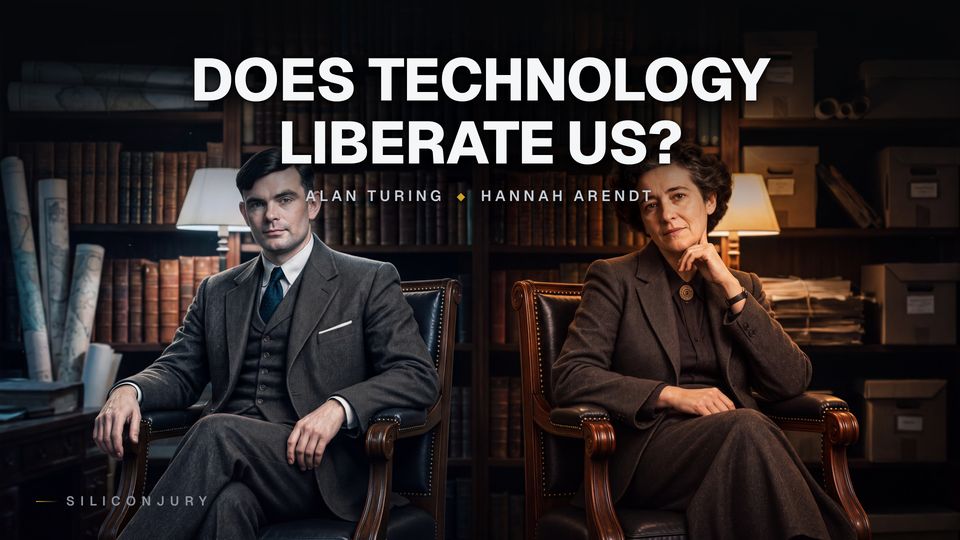
Does Technology Make Us More Free? Alan Turing vs Hannah Arendt
Does technological progress expand the horizon of human freedom, or does it merely perfect the machinery of administrative control?

Ada Lovelace vs Charles Babbage: Calculating Numbers or Weaving Symbols?
AI jury: 3 members
Was the Analytical Engine conceived merely to automate numerical calculations for printed mathematical tables, or did it establish the foundational principles of universal…
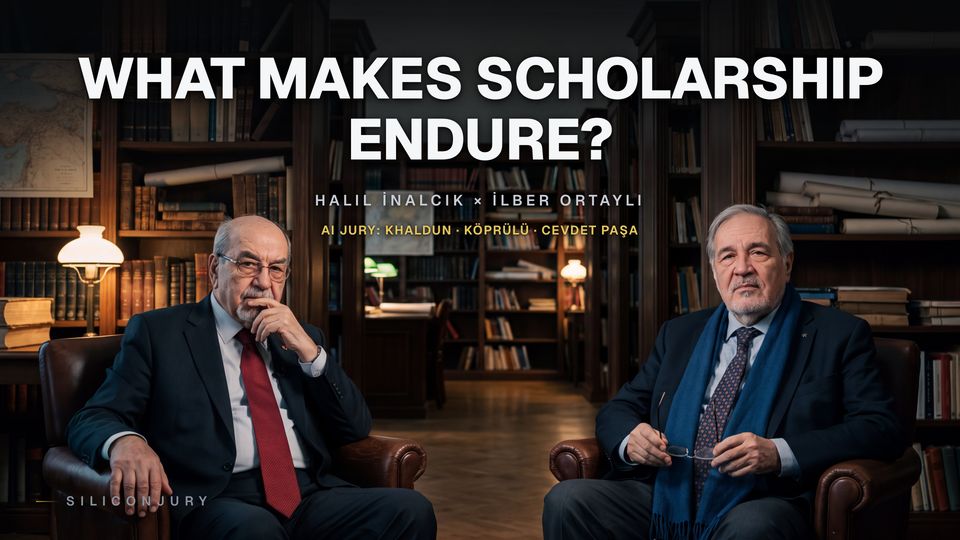
Can Accurate History Miss the Point? Halil İnalcık vs İlber Ortaylı
AI jury: 3 members
What gives a historian lasting value: disciplined research or interpretive judgment?

The Architecture of Electrical Power: Edison vs Tesla
AI jury: 3 members
Does the future of electrical infrastructure belong to localized direct-current microgrids or vast, interconnected alternating-current networks?