Imposing higher political costs on domination is a…
- Publisher
- SiliconJury
- Language
- en · Localized adaptation
Topic
Imposing higher political costs on
domination is a commendable
achievement.
Yet redundant networks can also
facilitate far more insidious,
selective forms of tyranny.
If communications remain online,
an authoritarian state can monitor
metadata,
map dissident networks,
and silently arrest organizers without
incurring the domestic
and international outrage of a total
blackout.
Consider the deployment of satellite
internet in Ukraine
following Russia’s 2022 invasion.
Satellite constellations preserved
connectivity when terrestrial
power and telecommunications were
devastated,
empowering hospitals,
civil defense,
journalists,
and the military to maintain cohesion.
This is an undeniable example of
technology defending vital
capability under existential threat.
Yet this case also reveals a profound
structural vulnerability.
Critical communications rested upon
terminals,
orbital networks,
and the private discretion of a single
corporate executive
operating outside the democratic
jurisdiction of the sovereign
nation.
A private billionaire possessed the
unilateral power to restrict
or disable connectivity during
military operations.
Technology preserved a space for
resistance,
yet it exposed how critical
infrastructure can be alienated from
public democratic command.
The more indispensable a tool becomes,
the more urgent the question:
who commands the sovereign switch?
Available editions
Sources & references
Source references have not been supplied in this public edition record.
Published transcript
AI-assisted historical reconstruction
Imposing higher political costs on domination is a commendable
achievement.
Yet redundant networks can also facilitate far more insidious,
selective forms of tyranny.
If communications remain online,
an authoritarian state can monitor metadata,
map dissident networks,
and silently arrest organizers without incurring the domestic
and international outrage of a total blackout.
Consider the deployment of satellite internet in Ukraine
following Russia’s 2022 invasion.
Satellite constellations preserved connectivity when terrestrial
power and telecommunications were devastated,
empowering hospitals,
civil defense,
journalists,
and the military to maintain cohesion.
This is an undeniable example of technology defending vital
capability under existential threat.
Yet this case also reveals a profound structural vulnerability.
Critical communications rested upon terminals,
orbital networks,
and the private discretion of a single corporate executive
operating outside the democratic jurisdiction of the sovereign
nation.
A private billionaire possessed the unilateral power to restrict
or disable connectivity during military operations.
Technology preserved a space for resistance,
yet it exposed how critical infrastructure can be alienated from
public democratic command.
The more indispensable a tool becomes,
the more urgent the question:
who commands the sovereign switch?
Related episodes
Conscience and the superweapon
A preserved SiliconJury audiovisual production. Original written metadata and transcript are not verified against this historical file.

Mahmoud Hessabi vs Albert Einstein: Nuclear Access and Scientific Sovereignty
AI jury: 3 members
Should developing nations have unrestricted access to peaceful nuclear technology, or do the attendant geopolitical and safety risks demand strict limits?
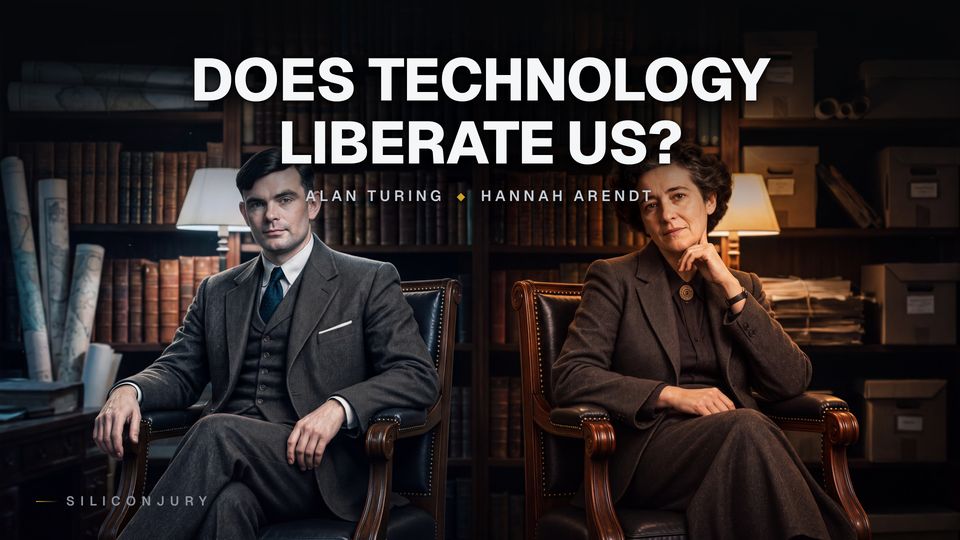
Does Technology Make Us More Free? Alan Turing vs Hannah Arendt
Does technological progress expand the horizon of human freedom, or does it merely perfect the machinery of administrative control?

Ada Lovelace vs Charles Babbage: Calculating Numbers or Weaving Symbols?
AI jury: 3 members
Was the Analytical Engine conceived merely to automate numerical calculations for printed mathematical tables, or did it establish the foundational principles of universal…

Can Accurate History Miss the Point? Halil İnalcık vs İlber Ortaylı
AI jury: 3 members
What gives a historian lasting value: disciplined research or interpretive judgment?

The Architecture of Electrical Power: Edison vs Tesla
AI jury: 3 members
Does the future of electrical infrastructure belong to localized direct-current microgrids or vast, interconnected alternating-current networks?