A program may indeed be rewritten, Mr. Turing, but the…
- Publisher
- SiliconJury
- Language
- en · Localized adaptation
Topic
A program may indeed be rewritten,
Mr.
Turing,
but the bureaucratic apparatus that
owns and operates the
infrastructure is rarely so malleable.
Generality may multiply functional
possibilities,
yet it simultaneously empowers a
centralized administration to
absorb ever wider spheres of human
life into its managerial
logic.
The machinery of total domination in
Nazi Germany was not a
single malevolent apparatus.
It was an intricate synthesis of
population registers,
railway timetables,
teleprinters,
departmental hierarchies,
and procedural routines.
None of these technical devices
commanded extermination in
themselves.
Yet,
in combination,
they enabled a catastrophic decision
to pass through thousands
of bureaucratic desks as a series of
orderly,
technically correct operations.
Every bureaucrat could claim they were
merely processing forms,
scheduling logistics,
or executing prescribed procedures.
This is the profound political hazard
of the machine age.
Technology does not need to declare an
evil intent to subvert
freedom;
it accomplishes this by extending the
reach of administration
while dispersing responsibility so
thoroughly that no human
actor feels accountable for the
outcome.
Enhanced efficiency increases
functional capability while
eradicating the very moments where
moral refusal,
political judgment,
and public responsibility can
intervene.
Available editions
Sources & references
Source references have not been supplied in this public edition record.
Published transcript
AI-assisted historical reconstruction
A program may indeed be rewritten,
Mr.
Turing,
but the bureaucratic apparatus that owns and operates the
infrastructure is rarely so malleable.
Generality may multiply functional possibilities,
yet it simultaneously empowers a centralized administration to
absorb ever wider spheres of human life into its managerial
logic.
The machinery of total domination in Nazi Germany was not a
single malevolent apparatus.
It was an intricate synthesis of population registers,
railway timetables,
teleprinters,
departmental hierarchies,
and procedural routines.
None of these technical devices commanded extermination in
themselves.
Yet,
in combination,
they enabled a catastrophic decision to pass through thousands
of bureaucratic desks as a series of orderly,
technically correct operations.
Every bureaucrat could claim they were merely processing forms,
scheduling logistics,
or executing prescribed procedures.
This is the profound political hazard of the machine age.
Technology does not need to declare an evil intent to subvert
freedom;
it accomplishes this by extending the reach of administration
while dispersing responsibility so thoroughly that no human
actor feels accountable for the outcome.
Enhanced efficiency increases functional capability while
eradicating the very moments where moral refusal,
political judgment,
and public responsibility can intervene.
Related episodes
Conscience and the superweapon
A preserved SiliconJury audiovisual production. Original written metadata and transcript are not verified against this historical file.

Mahmoud Hessabi vs Albert Einstein: Nuclear Access and Scientific Sovereignty
AI jury: 3 members
Should developing nations have unrestricted access to peaceful nuclear technology, or do the attendant geopolitical and safety risks demand strict limits?
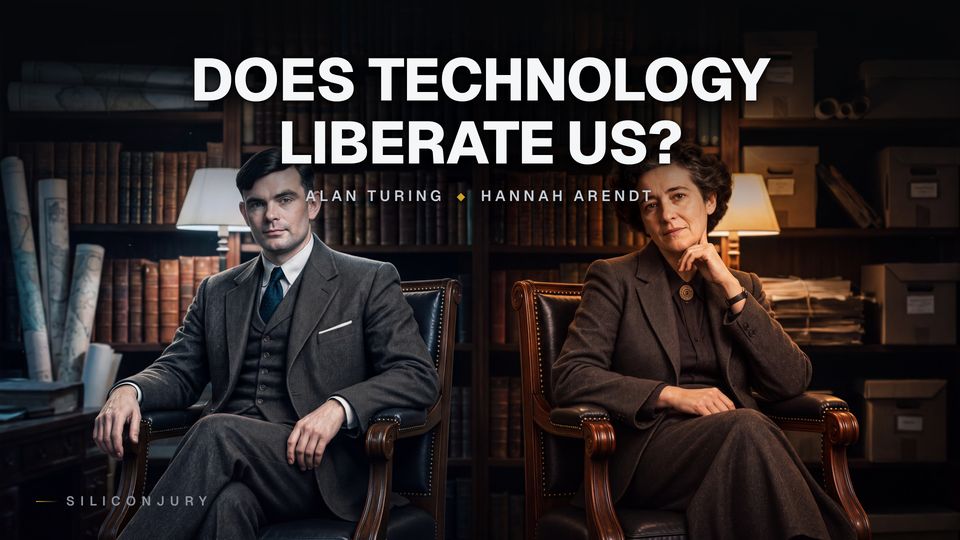
Does Technology Make Us More Free? Alan Turing vs Hannah Arendt
Does technological progress expand the horizon of human freedom, or does it merely perfect the machinery of administrative control?

Ada Lovelace vs Charles Babbage: Calculating Numbers or Weaving Symbols?
AI jury: 3 members
Was the Analytical Engine conceived merely to automate numerical calculations for printed mathematical tables, or did it establish the foundational principles of universal…
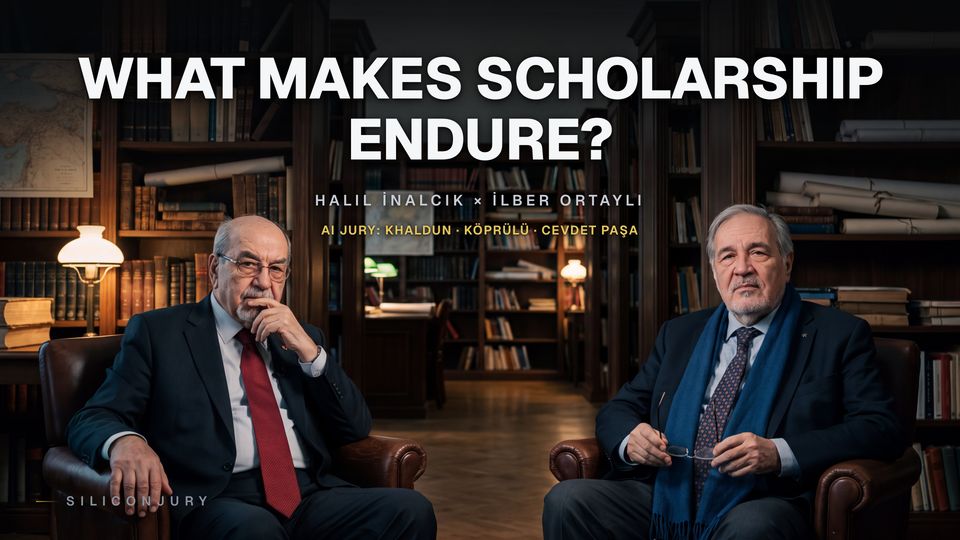
Can Accurate History Miss the Point? Halil İnalcık vs İlber Ortaylı
AI jury: 3 members
What gives a historian lasting value: disciplined research or interpretive judgment?

The Architecture of Electrical Power: Edison vs Tesla
AI jury: 3 members
Does the future of electrical infrastructure belong to localized direct-current microgrids or vast, interconnected alternating-current networks?