You rightly observe that capability is not synonymous…
- Publisher
- SiliconJury
- Language
- en · Localized adaptation
Topic
You rightly observe that capability is
not synonymous with
freedom.
My point,
however,
is that without material capability,
freedom degenerates into empty
ceremony.
A citizen may formally possess the
right to speak,
assemble,
organize,
or dissent;
yet if the physical means are
inaccessible,
that right remains an abstract
hypothesis.
Consider the stored-program computer
developed at Manchester.
The very essence of the universal
machine is that its hardware
remains open:
change its instructions,
and it executes a radically different
task.
This generality broke the monopoly of
single-purpose machinery,
placing power in the hands of users
who could define their own
purposes.
Calculation,
modeling,
cryptanalysis,
and communication ceased to be
isolated mechanical destinies and
became applications of a flexible,
shared medium.
Ownership can certainly be
monopolized,
and software can be enlisted in the
service of tyranny.
But these are contingent political
variables,
not inherent technological
imperatives.
A general-purpose technological
substrate expands the space of
possible human actions.
Just institutions must ensure
equitable access,
but an adaptable technological
baseline provides both
institutions and citizens with far
more avenues for autonomous
action than a world bounded by static
tools.
Available editions
Sources & references
Source references have not been supplied in this public edition record.
Published transcript
AI-assisted historical reconstruction
You rightly observe that capability is not synonymous with
freedom.
My point,
however,
is that without material capability,
freedom degenerates into empty ceremony.
A citizen may formally possess the right to speak,
assemble,
organize,
or dissent;
yet if the physical means are inaccessible,
that right remains an abstract hypothesis.
Consider the stored-program computer developed at Manchester.
The very essence of the universal machine is that its hardware
remains open:
change its instructions,
and it executes a radically different task.
This generality broke the monopoly of single-purpose machinery,
placing power in the hands of users who could define their own
purposes.
Calculation,
modeling,
cryptanalysis,
and communication ceased to be isolated mechanical destinies and
became applications of a flexible,
shared medium.
Ownership can certainly be monopolized,
and software can be enlisted in the service of tyranny.
But these are contingent political variables,
not inherent technological imperatives.
A general-purpose technological substrate expands the space of
possible human actions.
Just institutions must ensure equitable access,
but an adaptable technological baseline provides both
institutions and citizens with far more avenues for autonomous
action than a world bounded by static tools.
Related episodes
Conscience and the superweapon
A preserved SiliconJury audiovisual production. Original written metadata and transcript are not verified against this historical file.

Mahmoud Hessabi vs Albert Einstein: Nuclear Access and Scientific Sovereignty
AI jury: 3 members
Should developing nations have unrestricted access to peaceful nuclear technology, or do the attendant geopolitical and safety risks demand strict limits?
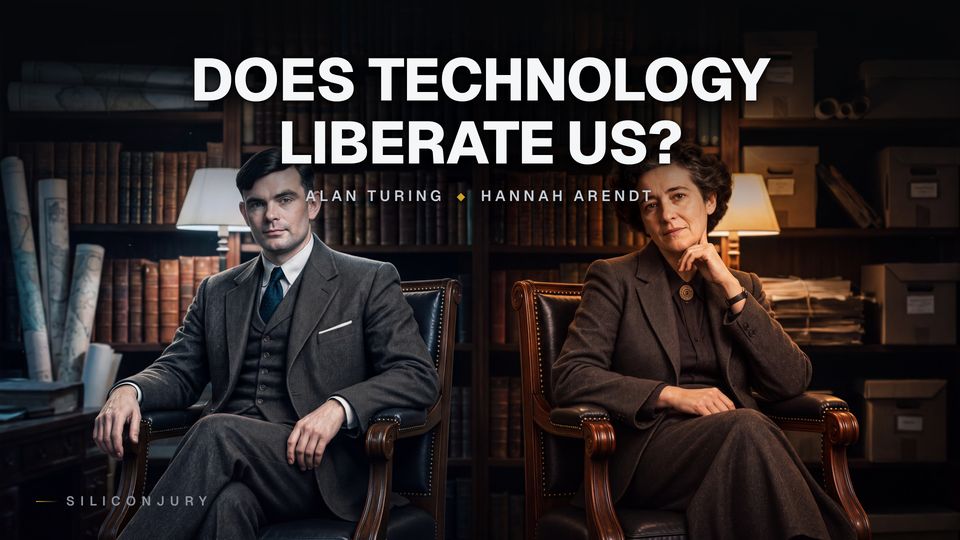
Does Technology Make Us More Free? Alan Turing vs Hannah Arendt
Does technological progress expand the horizon of human freedom, or does it merely perfect the machinery of administrative control?

Ada Lovelace vs Charles Babbage: Calculating Numbers or Weaving Symbols?
AI jury: 3 members
Was the Analytical Engine conceived merely to automate numerical calculations for printed mathematical tables, or did it establish the foundational principles of universal…

Can Accurate History Miss the Point? Halil İnalcık vs İlber Ortaylı
AI jury: 3 members
What gives a historian lasting value: disciplined research or interpretive judgment?

The Architecture of Electrical Power: Edison vs Tesla
AI jury: 3 members
Does the future of electrical infrastructure belong to localized direct-current microgrids or vast, interconnected alternating-current networks?